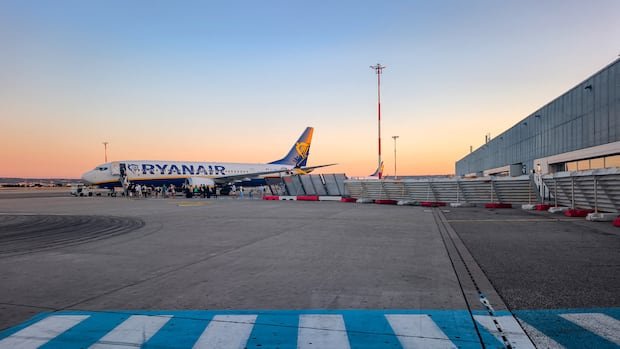
A Ryanair aircraft encountered a terrifying incident last month in Greece when a broken engine part shattered a window shortly after takeoff, leading to a passenger’s head being sucked out before fellow passengers managed to pull him back inside, according to U.S. investigators. The incident involved a fan blade in the right engine of the Boeing 737-800 breaking loose, causing damage to the window and fuselage. The U.S. National Transportation Safety Board (NTSB) conducted a preliminary investigation after Greece handed over the case in line with international aviation regulations.
The mishap occurred on July 10 after the flight departed from Thessaloniki, Greece. Investigators discovered bird remnants inside the engine, suggesting a possible bird strike during takeoff, although the exact cause of the fan blade detachment remains undetermined. The 61-year-old passenger involved in the incident sustained neck and shoulder injuries as well as friction burns.
Flight attendants recounted hearing loud vibrations and witnessing smoke or fog in the cabin, prompting the release of emergency oxygen masks. Passengers in Row 11 noticed the man caught in the damaged window and promptly pulled him back inside the aircraft. Subsequently, the injured passenger received medical attention in Row 12, with others using a metal box to block the window opening until landing was possible.
Videos from inside the plane depicted passengers donning oxygen masks due to pressure loss in the cabin, as well as the aftermath of the incident with emergency responders on-site. Maintenance records revealed that the failed engine’s fan blades had undergone ultrasonic inspections in May 2026 and November 2025 without any identified damage. However, flight crews had previously reported four suspected bird strikes on the same engine, with bird remains discovered after two incidents.
In response to the incident, Ryanair CEO Michael O’Leary faced criticism from the NTSB for prematurely commenting on the investigation’s focus. Ryanair, Boeing, and CFM International are cooperating with the ongoing investigation. Following prior fan blade failures on Boeing 737s, the FAA issued directives in April 2025 to fortify engine coverings on the aircraft. These modifications aim to prevent engine covering pieces from detaching and causing harm in case of fan blade detachment. The NTSB report highlighted that the necessary changes had not been implemented on the Ryanair plane by the July 2028 deadline set by the FAA.
The FAA refrained from commenting on the active investigation, emphasizing its support for the NTSB and commitment to implementing safety measures based on evidence. The aircraft involved in the incident, a 737-800 operated by Malta Air, a Ryanair subsidiary, was delivered new in 2008 and can accommodate up to 189 passengers. Flight data indicated a brief climb and descent after the incident, with the plane safely returning to Thessaloniki. Passengers were unharmed, and one individual received medical attention upon landing.