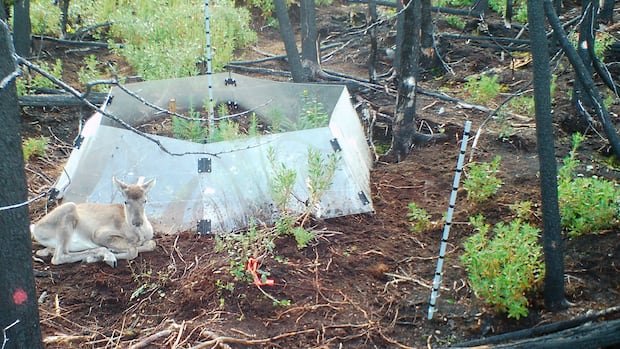
A researcher studying forest regrowth after wildfires in Newfoundland is facing challenges as local wildlife continuously disrupt his work. Lucas Brehaut, a wildfire research scientist, is investigating how forests in Atlantic Canada recover post-fire, amid increasing wildfire occurrences. To simulate the effects of a warming planet, Brehaut and his team have set up 19 open-top chambers (OTCs) to monitor seedlings’ growth by raising temperatures slightly. However, various animals, including caribou, moose, black bears, wolves, rabbits, and owls, have been damaging the equipment and even stealing temperature sensors.
Despite the setbacks, Brehaut remains understanding, acknowledging that the animals are simply exploring their habitat. Kaitlyn Gaynor, an assistant professor at the University of British Columbia, explains that animals are naturally curious about new objects in their environment, driven by the potential for food sources or threats. She emphasizes that researchers can minimize the impact on animals by reducing their presence and scent in the field.
Animal interference with research is a global phenomenon, as Gaynor has experienced in Mozambique, where baboons and hyenas disrupt research activities. Elephants, known for their intelligence and curiosity, pose significant challenges by damaging research equipment. Brehaut has also encountered human-related disruptions, such as snowmobiles accidentally damaging his research sites in snowy Newfoundland winters.