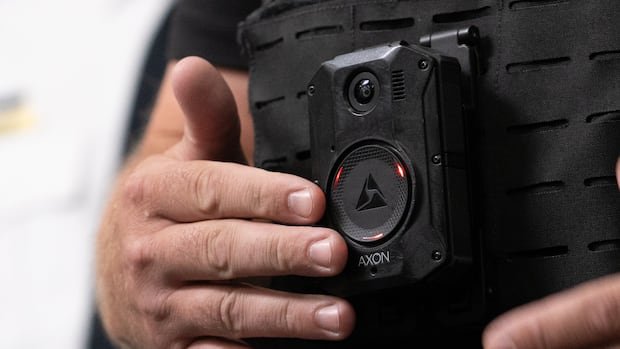
The Edmonton Police Service made an announcement on Tuesday, revealing its groundbreaking initiative to be the first law enforcement agency globally to implement Axon Enterprise’s artificial intelligence (AI) technology in testing facial-recognition-capable body cameras.
Acting Supt. Kurt Martin of EPS’ information and analytics division emphasized during a press briefing that the facial-recognition technology is not intended to replace human investigative efforts. Martin clarified that any identifications made by the software would be verified by trained officers proficient in facial recognition.
The primary objective for the police force is to explore additional tools that can enhance public and officer safety while upholding privacy rights. Axon Enterprise, based in Arizona, specializes in manufacturing weapons and technology for military, law enforcement, and civilians in permissible jurisdictions.
Commencing Wednesday, up to 50 Edmonton police officers equipped with body cameras will begin using Axon’s facial-recognition-enabled devices throughout the remainder of the month.
The decision to trial the technology stems from the provincial government’s mandate in 2023 requiring all police officers in Alberta to use body cameras, with EPS commencing the rollout in 2024.
EPS stressed that the collaboration with Axon is independent of the provincial mandate and serves as a limited trial period to evaluate the viability and functionality of integrating facial recognition with body-worn cameras for policing purposes.
The trial aims to assess the technology’s capacity to aid officers in identifying individuals on warrants for serious offenses like murder, aggravated assault, and robbery, ensuring timely execution of warrants in adherence to legal processes.
During field operations, officers will activate the facial-recognition system on the body cameras when necessary for investigations or enforcement actions, with the technology running in silent mode to automatically process facial data within a designated range without alerting officers. Any non-matching facial data is promptly discarded to preserve privacy.
Following data capture, EPS officers trained in facial-recognition analysis will scrutinize the footage to evaluate the software’s performance and accuracy in generating matches.
The potential concerns associated with facial-recognition technology were highlighted by experts, including Ian Adams of the University of South Carolina and Diane McLeod, Alberta’s information and privacy commissioner. The technology’s accuracy, privacy implications, and regulatory compliance were underscored as critical areas of scrutiny.
The final decision on the continued use of facial-recognition bodycams in 2026 will be subject to review by the Edmonton police commission and the chief’s committee.