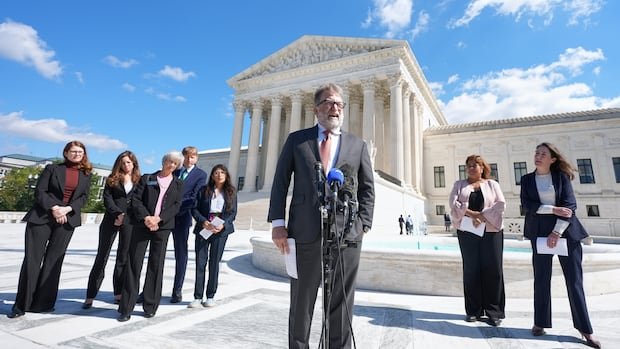
The U.S. Supreme Court grappled on Monday with the question of whether local governments have the right to sue oil and gas companies in state courts to help cover expenses related to climate change, a matter that could involve billions of dollars. Key justices seemed cautious about the extensive nature of potential lawsuits but were undecided on the intricate legal issues presented by the case.
Officials in Boulder, Colorado, claim that their lawsuit aims to hold Suncor, a Canada-based company, and ExxonMobil, a U.S.-based company, accountable for their role in climate change. They argue that the increasing frequency of disasters such as floods and wildfires places a significant financial burden on local communities, and the industry should share in the responsibility.
The city and county of Boulder initially filed lawsuits against the oil companies in 2018, well before the 2021 Marshall Fire that destroyed nearly 1,100 homes and caused two fatalities, resulting in an estimated $2 billion in damages — the most expensive wildfire in Colorado’s history.
Energy companies argue that a surge of state court lawsuits is not the appropriate method to address the global climate issue. Justices expressed concerns about potential widespread litigation consequences if Boulder succeeds, with Chief Justice John Roberts questioning the practical implications of such a scenario.
Various U.S. municipalities from predominantly Democratic-leaning regions have lodged similar lawsuits, seeking substantial damages as part of a global trend of legal actions utilizing courts to drive climate change response. Justice Brett Kavanaugh warned that a victory for Boulder could financially ruin not only the oil companies but also other potential defendants, suggesting that any entity could become a target under such lawsuits.
Suncor and Exxon contend that the authority to regulate emissions lies with the federal government under the Clean Air Act, not with individual states. They are supported by the Trump administration, which argues that these lawsuits are an unconstitutional effort to control emissions and enforce Colorado’s laws beyond its borders.
The case was heard without Justice Samuel Alito, who recused himself shortly before the arguments due to owning stock in oil companies, possibly leading to a tied vote. The absence of a majority decision would uphold a ruling from Colorado’s highest court allowing the lawsuit to proceed.
Lawyers representing the industry underscored the importance of congressional action in addressing climate change rather than relying on court decisions. Boulder’s case, they argue, oversteps the state’s authority by seeking to attribute damages predominantly caused outside Colorado to local actions.
The court is considering a jurisdictional issue that could delay a definitive ruling, with Justice Ketanji Brown Jackson suggesting a wait-and-see approach until state court proceedings conclude. The outcome of the case is anticipated in the upcoming months, with a decision expected by the end of next June, as reported by Reuters.