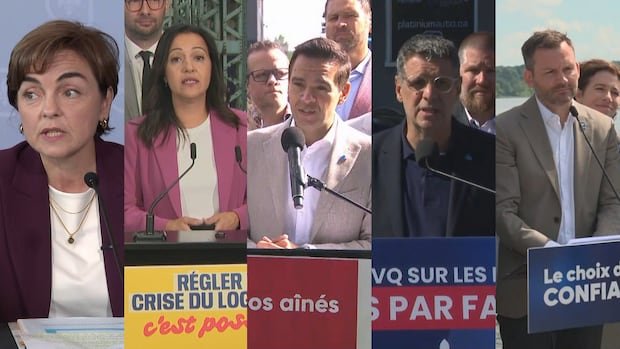
Sunday marks the fourth day of Quebec’s election campaign, with a strong focus on affordability in most promises, except for the Parti Québécois (PQ) emphasizing the protection of the French language.
The PQ aims to expand the Charter of the French Language, also known as Bill 101, to include CEGEPs and children of temporary immigrants residing in Quebec for over a year.
The Coalition Avenir Québec (CAQ), led by Christine Fréchette, is committed to achieving a balanced budget by 2030 despite facing a $6 billion deficit. Their electoral pledges are estimated to cost nearly $10 billion over the next five years, with initiatives such as allocating $1 billion for home care services and senior housing measures. Additionally, $304 million will be allocated to support regional development. The CAQ plans to maintain investments in public infrastructure and address the challenges posed by the 50% tariffs imposed by U.S. President Donald Trump, delaying any tax cuts until a balanced budget is achieved.
Québec Solidaire (QS), represented by Ruba Ghazal, unveiled a comprehensive housing plan on Sunday, criticizing the CAQ’s approach to the housing crisis. QS’s plan includes measures like establishing a national registry of rental units, preventing evictions, combating illegal Airbnb units, and advocating for neighborhood densification. The party also proposes a national strategy to eradicate homelessness, with detailed financing plans to be disclosed in their upcoming fiscal framework.
Quebec Liberal Leader Charles Milliard pledged to cap rent increases at private seniors’ residences, shifting the burden of proof away from residents when contesting rent hikes. This initiative aims to alleviate financial pressures on seniors without compromising essential services. The Quebec Liberals highlight the 18% increase in private home care rent over the past four years and emphasize the need for better housing protections for seniors.
The Conservative Party of Quebec (PCQ), led by Éric Duhaime, announced plans to eliminate the Quebec sales tax on used goods, projecting an average savings of $867 per Quebec household. This measure is part of the party’s strategy to cut $47 billion in government spending over five years without affecting public services. The PCQ also aims to safeguard forestry jobs by abolishing the carbon tax, promoting local producers, and enhancing the use of Quebec wood in public projects.
Parti Québécois leader Paul St-Pierre Plamondon reiterated his commitment to extending Bill 101 to CEGEPs and the children of temporary immigrants, citing a “linguistic emergency” in Quebec. He advocates for stricter French language requirements for work permits and proposes an examination of the language of socialization in Montreal and Laval schools. St-Pierre Plamondon stresses the importance of preserving French as a fundamental aspect of Quebec’s identity and sovereignty aspirations.