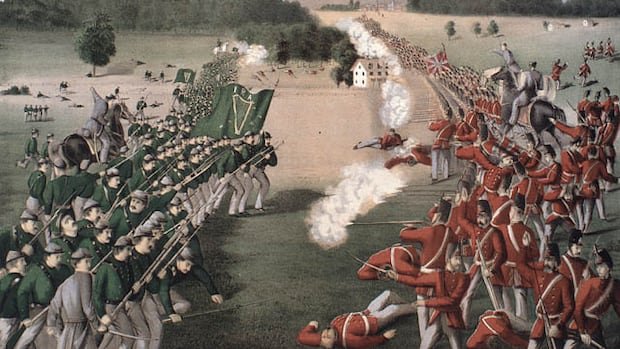
An overlooked clash on Canadian territory, occurring a year prior to Confederation, may not resonate widely with Canadians beyond Fort Erie, Ontario, but holds significance in various aspects of history. The 1866 Battle of Ridgeway, also known as Limestone Ridge, marked the first instance of Canadian troops under Canadian leadership engaging in combat. This event served as the precursor to Decoration Day, a predecessor to Remembrance Day observed in certain regions annually. Despite this, the nine individuals who lost their lives in the battle are notably absent from the Books of Remembrance, a collection on Parliament Hill honoring Canadian service members who died for their country.
A new petition, championed by Conservative MP Fred Davies, aims to include these nine fallen soldiers and the numerous others who perished post-battle in the official list. Davies, representing the Niagara South riding which encompasses Fort Erie, where the battle unfolded, emphasized the importance of acknowledging these sacrifices on a national level.
The Battle of Ridgeway was characterized by a mismatched confrontation, pitting inexperienced Canadian volunteers against battle-hardened Fenian raiders, predominantly veterans of the American Civil War. The Fenian Brotherhood, an Irish American movement advocating for Irish independence, sought to achieve their goals by invading British North America. In response, approximately 800 Canadian volunteers from various regiments confronted the raiders at Limestone Ridge near Ridgeway and Fort Erie.
Historian Peter Vronsky highlighted the swift mobilization of Canadian forces from the Golden Horseshoe area, despite their lack of preparation for what he termed as Canada’s inaugural modern battle. Despite facing challenges like inadequate supplies and ammunition shortages, the Canadian troops engaged the invaders in combat, leading to a scattered retreat following a Fenian assault. While the battle resulted in a tactical defeat, the Fenians were repelled, marking a symbolic victory for the Canadians.
Davies underscored that the battlefield outcome at Ridgeway does not diminish the valor of those who perished defending Canada. He stressed the importance of recognizing their contributions, regardless of the battle’s shortcomings in organization and readiness.
A memorial erected in 2016 commemorates the nine soldiers who fell at Ridgeway, yet efforts to have their names added to the Books of Remembrance have been unsuccessful. Fort Erie Mayor Wayne Redekop emphasized the significance of acknowledging these individuals and their role in shaping Canada’s history.
Despite occurring before the official formation of Canada, the Battle of Ridgeway holds historical relevance, with its impact extending to the Confederation process. Vronsky suggested that the battle played a pivotal role in uniting Canadians and shaping the nation’s identity.
Several regiments that participated in the 1866 battle, such as the Queen’s Own Rifles and the Royal Hamilton Light Infantry, continue to exist today, symbolizing the legacy of Canada’s modern armed forces. The battle also inspired Alexander Muir to compose “The Maple Leaf Forever,” a patriotic ballad, possibly drawing inspiration from the maple leaf symbol of the Queen’s Own Rifles insignia.
In essence, the Battle of Ridgeway stands as a testament to Canadians fighting for their homeland, underscoring a shift towards a national identity separate from British colonial ties.