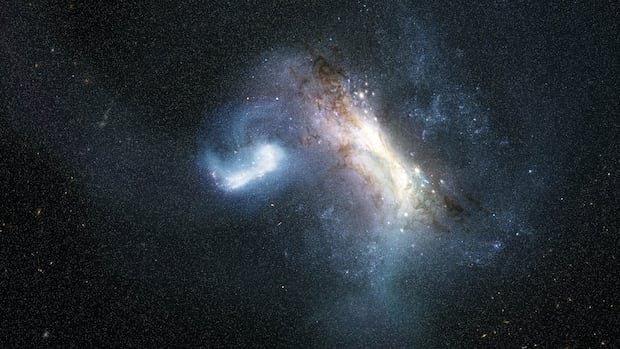
A recent study has shed light on the early history of the Milky Way galaxy, revealing a significant event that occurred billions of years ago. Researchers have found evidence of a galactic merger that took place approximately 11.8 billion years ago, when the universe was still in its infancy.
The study, published in the journal Nature Astronomy, details how the Milky Way absorbed a smaller dwarf galaxy, known as Low-energy-Kraken-Heracles (LKH), which contained stars equivalent to 500 million times the mass of the sun at the time of the merger. This event, the earliest-known galactic merger for the Milky Way, played a crucial role in shaping the galaxy’s structure and growth.
Utilizing data from the Hubble and Gaia telescopes, scientists studied stellar clusters within the Milky Way’s innermost regions to analyze their age, composition, and trajectory. The findings suggest that the merger injected a vast amount of stars, interstellar gas, and dark matter into the Milky Way, fueling star formation and contributing to its evolution.
Lead researcher Davide Massari emphasized that while the merger was peaceful for stars, it triggered an explosive interaction between the gas from the dwarf galaxy and the Milky Way, leading to the formation of numerous stars. This discovery adds to our understanding of the Milky Way’s complex history, which has also involved two other major galactic mergers over the past billions of years.
Massari highlighted the importance of studying the Milky Way’s past to unravel the origins of our solar system and Earth, emphasizing how each merger has left a lasting impact on the galaxy’s development. The ongoing research into the Milky Way’s history continues to provide insights into fundamental questions about our cosmic origins.