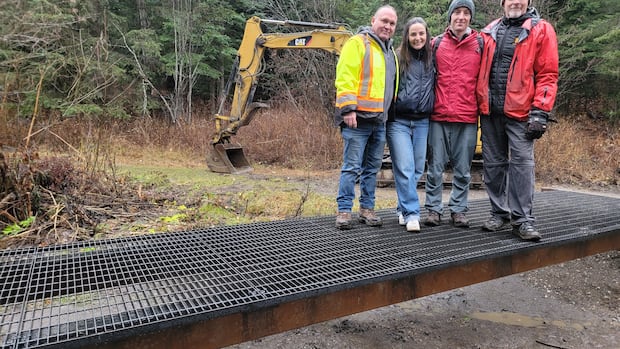
As the lyrics suggest, being green can be quite challenging.
However, a newly constructed bridge over an amphibian migration route in a park located in Prince George is anticipated to provide small salamanders, toads, and frogs with a better chance of survival each summer.
Visitors can now traverse the bridge, allowing them to walk above the migration path and prevent inadvertently crushing the vulnerable young creatures as they transition from the lake to the forest during July and August.
This eight-meter bridge is situated on the northwest shore of Shane Lake in Forests for the World, a vast natural park that shelters wildlife such as black bears, moose, and deer, as well as smaller species like long-toed salamanders, western toads, wood frogs, and Columbia spotted frogs.
The bridge project was a collaborative effort involving the City of Prince George, local firm Nahanni Construction, and other entities, with the construction concluding on November 12.
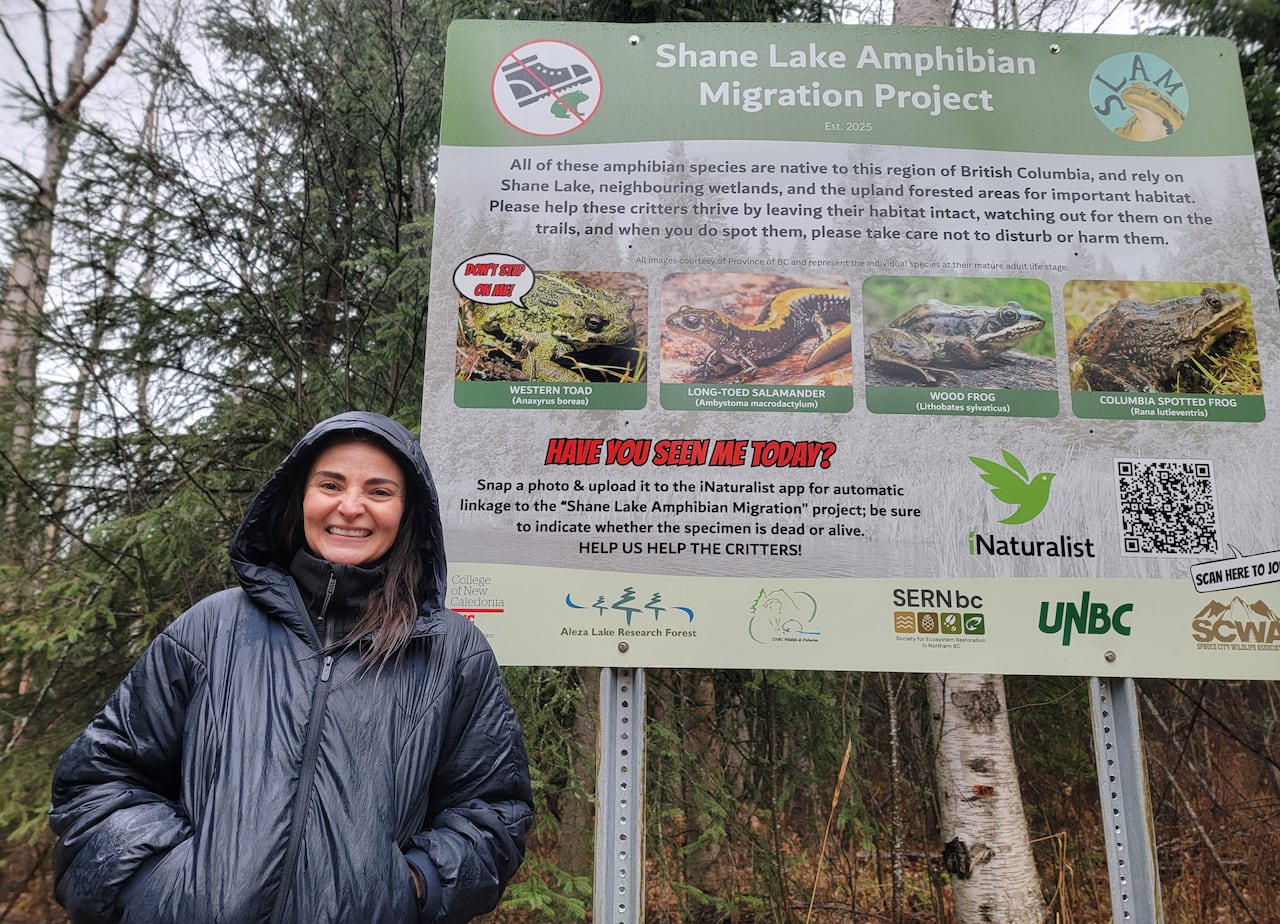
Ashley Sutherland has placed signs throughout various locations in Forests for the World park in Prince George, B.C., to educate visitors about avoiding stepping on small frogs and other amphibians near Shane Lake. (Jason Peters/CBC)
Among the contributors is Ashley Sutherland, a Prince George resident and professional forester who is not an amphibian expert. She first highlighted the trampling issue after a walk with her dogs by Shane Lake in early August 2022.
“I saw it firsthand, and honestly, it upset me,” Sutherland shared. “I returned to the parking area, emailed the city, and that’s the reason behind this initiative. It frustrated me that nothing was being done about it,” she explained.
Sutherland did not anticipate becoming the advocate for this cause, but that’s how things unfolded. With backing from local and even provincial supporters, she managed to have signs erected in the park to raise awareness about the trampling problem.
Now, the bridge is operational and being utilized.
From Sutherland’s viewpoint, this serves as a prime example of what can be achieved when individuals or groups come together to address an issue.
“[The bridge] signifies a true partnership with the City of P.G., and it represents doing the right thing,” she remarked.
“Thanks to that city collaboration, and with numerous organizations and individuals involved, it’s incredible to be part of meaningful change.”
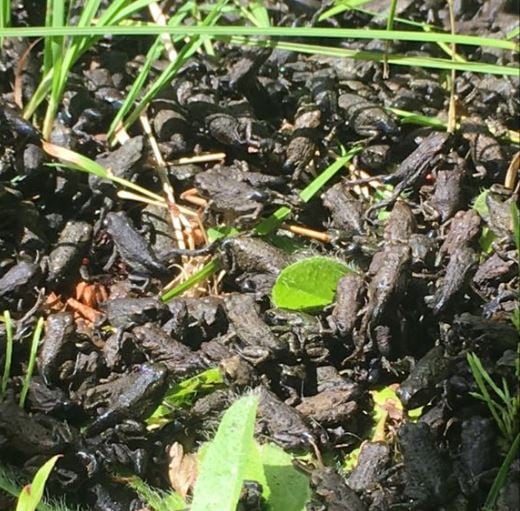
Among the species utilizing the amphibian migration routes around Shane Lake in Forests for the World park in Prince George, B.C., are western toads, wood frogs, and Columbia spotted frogs. This image was captured near the lake’s edge. (Submitted by Ashley Sutherland)
Small size and green color pose a risky challenge
During the migration of salamanders, toads, and frogs at Shane Lake in July and August, the numbers are not just in the dozens.
Sutherland reports that they migrate in the thousands, and their diminutive size and coloration often make them hard to spot, which increases their vulnerability to being stepped on by users of the trails.
“Data from 2025 indicated that the main loop trail surrounding the lake experienced a mortality rate as high as 12.8 per cent,” Sutherland noted, clarifying that not all fatalities were due to trampling.
In the broader ecological context around Shane Lake, Sutherland emphasizes that aiding the local amphibians in surviving their migration from the lake to the woods is crucial, as only about one in every 100 reaches full maturity.
“So, while we see thousands on the trail, that doesn’t necessarily indicate that amphibian populations are thriving in terms of their reproductive success,” she explained.
-
5 million amphibians and reptiles relocated for B.C. development, with no requirement to monitor survival: study
-
New wildlife tunnels constructed near Tofino, B.C., protect amphibians from a perilous game of Frogger
While a complete cost estimate for the bridge is not available, Dean Price from Nahanni Construction stated that the City of Prince George funded approximately 30 percent of the costs, with the remainder covered by donations.
Michael Le Morvan from the parks department of the City of Prince George described the project as “wonderful” and mentioned that plans for a second bridge at another amphibian crossing are already underway.
“We are intending to construct another one, likely 100 meters from this location,” he added.