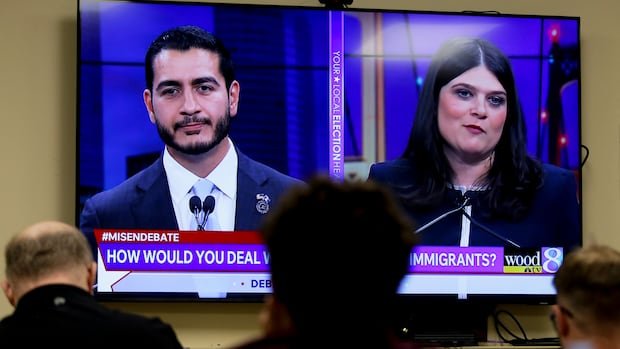
A contentious Democratic Senate primary in Michigan is emerging as a battleground for discussions on money in politics, the influence of the pro-Israel lobby, and the future of U.S.-Israel relations within the party. The clash between four-term Congresswoman Haley Stevens and her opponent, Abdul El-Sayed, a progressive public health official endorsed by Senator Bernie Sanders, has revolved around issues like health care, ICE, campaign funding, and foreign policy.
Various groups have spent over $60 million to support Stevens in what is now the most expensive Democratic primary ever, with half of the funds, exceeding $30 million, coming from the American Israel Public Affairs Committee (AIPAC) and its related organizations. The shift in perceptions of AIPAC within the Democratic Party has become a polarizing topic, as highlighted by history professor Doug Rossinow.
While Stevens has a history of supporting Israel and upholding a two-state solution, El-Sayed advocates for ending unconditional U.S. military aid to Israel, labeling it a “rogue state” responsible for a “horrific genocide” in Gaza. The debate over AIPAC funding has been prominent in their campaign, with El-Sayed criticizing the organization’s substantial spending to support Stevens.
The primary race in Michigan reflects differing views on the U.S.-Israel relationship, with El-Sayed’s platform aligning with criticisms of big money in politics. The involvement of AIPAC has sparked concerns and debates among voters, with implications extending beyond the state’s borders.
As the primary election unfolds, the role of AIPAC and its impact on the Democratic Party’s future remain under scrutiny. The outcome of this race is anticipated to have far-reaching consequences, shaping the party’s stance on foreign policy, campaign financing, and broader political dynamics.
The battle between Stevens and El-Sayed signifies a pivotal moment in U.S. politics, where discussions on foreign policy, money in politics, and party ideologies converge.