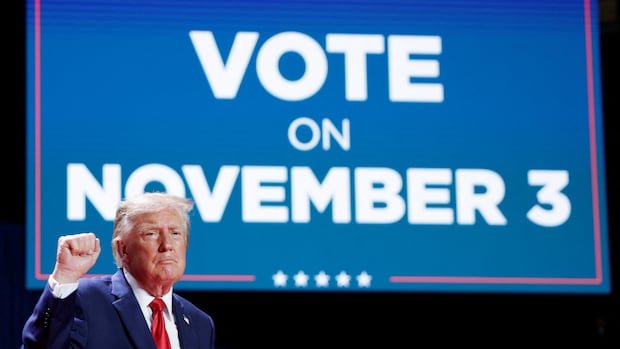
Two legal actions were initiated on Wednesday challenging the recent federally funded television advertisements of U.S. President Donald Trump, which are viewed as promoting his political agenda at the expense of taxpayers. The Democratic National Committee (DNC) filed the first lawsuit against the Republican administration, alleging that the ads constitute illegal government-sponsored propaganda, with accusations of personal direction by Trump. Subsequently, a separate lawsuit was filed by a coalition, including the non-partisan watchdog Common Cause, also claiming an unlawful use of funds.
Both lawsuits sought federal judges to halt the utilization of federal funds for these ads. These legal challenges mark the initial opposition to the television commercials, which have received criticism from both sides of the political spectrum for glorifying Trump and advancing his campaign message ahead of November’s midterm elections. The ads, which commenced airing in September and are frequently featured during weekend sports broadcasts, have already incurred over $12 million in costs, as reported by the media tracking firm AdImpact. The Department of Homeland Security awarded a $20-million contract for this advertising campaign to a company in Maryland.
In response to the backlash on Monday, Trump defended the ads as a form of “positive promotion for our Great U.S.A.,” indicating a shift to fund them through his MAGA Inc. super PAC moving forward. However, a fifth ad started airing on Tuesday, explicitly stating it was funded by the U.S. government, highlighting Trump’s military efforts in capturing Nicolás Maduro in Venezuela earlier this year. Despite Trump’s pledge to transition to external funding, he has not committed to reimbursing the money already spent, stating “we’ll decide,” in remarks to reporters.
DNC Chair Ken Martin criticized Trump for misusing taxpayer money in a bid to bolster Republicans’ prospects in the upcoming elections, emphasizing the need for better use of citizens’ hard-earned tax dollars. An individual familiar with the ad campaign, speaking on condition of anonymity, disclosed that the ad buys planned before Trump’s announcement to shift funding to his super PAC would conclude this week, with external groups taking over payments thereafter.
The second lawsuit, filed by legal advocacy group Democracy Forward on behalf of Common Cause, a New York public employee union, and a Democratic state legislative candidate in Alabama, echoed the sentiment that taxpayers should not be burdened with financing the president’s political agenda. Omar Noureldin, senior vice-president of policy and litigation at Common Cause, expressed skepticism regarding Trump’s commitment to relying on external funds for future ads, citing the airing of the new government-sponsored ad as evidence of ongoing scheduling.
Critics have argued that these ads violate federal statutes prohibiting the use of congressionally appropriated funds for “publicity or propaganda,” along with potential breaches of other federal laws. The funding for these ads, sourced from a $175-million package allocated by Congress to the Department of Homeland Security for Trump’s immigration enforcement initiatives, has raised legal concerns. Trump’s proposal to use his super PAC for funding also raises legal ambiguities, as super PACs are intended to operate independently from the politicians they support.
Amid mounting scrutiny, Democrats in Congress have called for formal investigations by government watchdogs, condemning the use of taxpayer dollars for what they perceive as Trump’s self-serving initiatives. The White House has defended these ads as public service announcements, likening them to past administrations’ efforts to promote policy objectives.
Federal Communications Commission Chair Brendan Carr dismissed calls for agency review of the ads, deeming them unremarkable and not warranting regulatory intervention. The distinct nature of these ads, diverging from traditional public service announcements, has raised concerns about their alignment with government objectives.
One of the ads closely resembles a spot from Trump’s 2024 presidential re-election campaign, emphasizing the removal of “warmongers” from government, mirroring criticisms of previous administrations’ military engagements. The upcoming midterm elections are poised to potentially shift the balance of power, with forecasts indicating the Republican Party may lose control of the House of Representatives. Trump’s promises of direct payments to Americans ahead of the elections have sparked debate but face hurdles for congressional approval. Additionally, the administration’s issuance of payments to healthcare.gov users has been met with scrutiny, with claims of refunding excessive fees under the previous administration.
The legal challenges and controversies surrounding these advertisements underscore the broader political landscape ahead of the midterm elections and the ongoing debates over the use of public funds for partisan messaging.