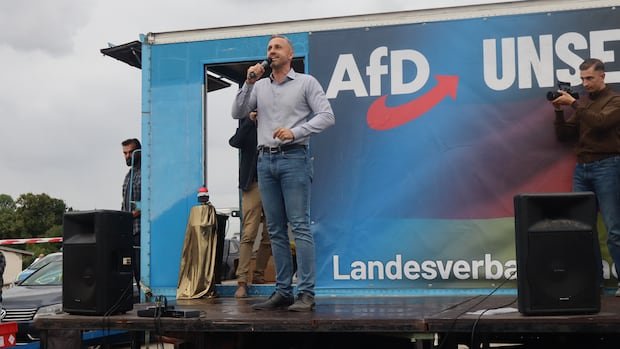
In a serene eastern German town called Quedlinburg, a sizable crowd gathered on a pleasant August day to listen to a prominent far-right figure speak about the future of the country. Many attendees arrived on their Simson motorcycles, emblematic of the Alternative for Germany (AfD) party, to meet Ulrich Siegmund, the AfD’s contender for leadership in Saxony-Anhalt, an eastern state.
With the AfD surging in popularity in opinion polls, there is a possibility that in an upcoming regional election, it could become the first far-right party to wield state authority in Germany since World War II. The party aims to exert significant influence over state resources, particularly in education, with proposed initiatives such as establishing segregated classrooms for refugees, fostering ties with Russia through student exchange programs, and promoting a patriotic agenda that shifts focus away from the nation’s Nazi history.
During the gathering, Luca Stemmler, aged 17, expressed admiration for Siegmund, regarding him as an inspirational figure speaking on behalf of the people. Meanwhile, across from the motorcycle rally, counter-protesters demonstrated solidarity by waving rainbow flags and singing songs of love in resistance to what they perceive as a threat to fundamental human rights and the democratic framework in postwar Germany.
The AfD’s rise in Saxony-Anhalt is reflected in opinion polls, with the party leading at 42%, according to research by Infratest-Dimap. Nationally, the AfD also holds a strong position at 28% in opinion polls and secured the second-largest number of seats in the federal election of 2025. Initially founded as an anti-Euro party in 2013, the AfD shifted its focus to immigration issues in 2015 amid the influx of refugees under Chancellor Angela Merkel’s administration.
The AfD advocates for policies such as “remigration,” which entails mass deportations of individuals from migrant backgrounds. In Saxony-Anhalt, the party pledges to restrict immigration from non-European Union nations deemed problematic, establish numerous deportation centers, and introduce segregated classrooms for refugee children. This stance has stirred mixed sentiments among residents like Akinola Sanyaolu, a Nigerian immigrant in Magdeburg, who faces discrimination but remains hopeful about his future in Germany.
The party’s government manifesto outlines specific objectives, including banning Pride flags in schools, revising history curricula to emphasize positive aspects of Germany’s past, and endorsing a traditional family structure comprising a father, mother, and children. As the AfD gains traction, concerns arise over its far-right inclinations, with experts cautioning about ties to extremist movements and potential implications for domestic intelligence services and foreign relations, particularly with Russia.
With the AfD’s possible ascension to power, apprehensions linger about its impact at both state and federal levels. The party’s success could challenge legislative initiatives and further legitimize its standing as a mainstream political force, signaling a shift in Germany’s political landscape. Amid a backdrop of societal dissatisfaction and political uncertainty, the AfD’s narrative resonates with segments of the population, drawing support from various quarters, including international figures like U.S. Vice-President JD Vance and entrepreneur Elon Musk.
If the AfD triumphs in the upcoming election, it could wield influence in the Bundesrat, Germany’s federal legislative chamber, potentially hindering legislative processes. Despite constitutional safeguards, the party’s electoral success could normalize its extremist views and bolster its narrative of victimization, shaping the country’s political discourse in unforeseen ways.