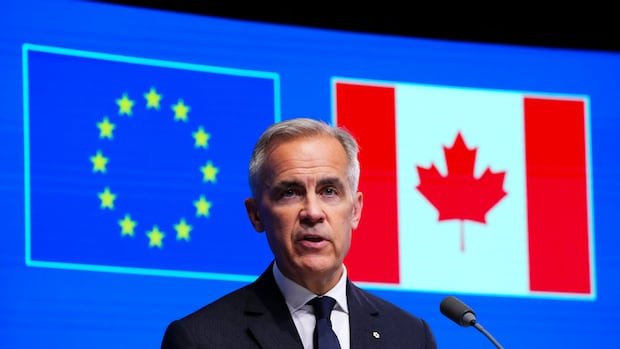
Prime Minister Mark Carney announced on Sunday that Canada is set to initiate talks regarding a distinctive partnership with the European Union. This announcement follows a report in the Wall Street Journal suggesting Canada’s interest in becoming an “associate member” of the EU, with Finnish President Alexander Stubb expressing a desire for Canada to be the 28th EU state rather than seen as the 51st state of the U.S.
In response to this report, Conservative Leader Pierre Poilievre and other MPs from his party voiced concerns on X, cautioning Canadians about the prospect of becoming the “28th EU state.” Carney emphasized at the Toronto International Film Festival that Canada is not aiming to become a full member of the EU but is exploring the possibility of forging a unique alliance based on shared values, priorities, and complementary strengths.
The idea of full EU membership for Canada has been informally circulated in media and political circles as Canada seeks to diversify its international ties beyond reliance on the U.S. French Foreign Minister Jean-Noël Barrot hinted at the possibility of Canada joining the EU in March, generating interest and discussion. However, Carney has consistently maintained that full membership is not on the agenda, emphasizing cooperation for mutual benefits without compromising Canada’s independence.
Carney is pushing for an elevated relationship between Canada and the EU, possibly leading to Canada being designated as an “Associate Member of the European Union.” While this title is not a legal status, it signifies a deeper level of partnership that Canada is exploring. Discussions are ongoing to outline the specifics of this relationship, with plans to unveil more details at the EU-Canada summit in October.
Both Carney and the EU’s ambassador to Canada, Geneviève Tuts, have highlighted the uniqueness of the potential partnership, focusing on enhancing security and economic cooperation. The two sides are considering closer collaboration in areas such as energy, artificial intelligence, critical minerals, and defense, aiming to provide more opportunities for Canadians in various sectors.
As discussions progress, experts speculate on the nature of the partnership, foreseeing potential agreements in critical mineral stockpiling, student exchanges, and digital trade. While details remain to be solidified, the focus is on strengthening ties between Canada and the EU through strategic collaborations rather than a comprehensive pact. The evolving relationship is anticipated to offer new avenues for cooperation and mutual benefit.
This article was originally sourced from CBC News.