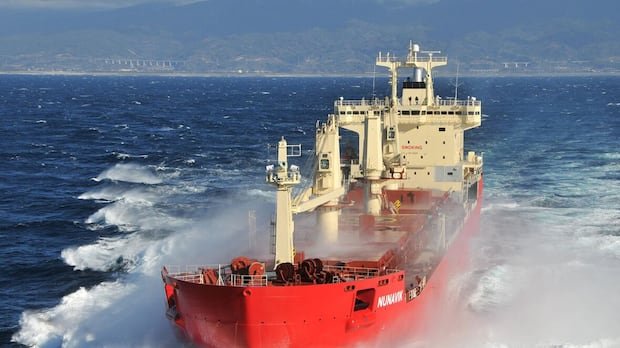
Premier Wab Kinew has estimated that constructing an expansion for the Port of Churchill, which includes an offshore liquefied natural gas terminal in Hudson Bay, would require a budget ranging from $70 to $80 billion. Recent research indicates that ice-strengthened cargo ships could safely sail through Hudson Bay beyond the usual four-month shipping season of the Port of Churchill. However, the studies highlight that fully loaded natural gas tankers, built to withstand sea ice, would face challenges maneuvering within the current port entrance due to its shallow and narrow design.
A feasibility study conducted by Arctic Gateway Group, the owner of the port and Hudson Bay Railway, concluded that significant dredging and infrastructure modifications or the development of an offshore loading facility would be necessary to accommodate such vessels at Churchill. Comparatively, the construction of a liquefied natural gas terminal in Kitimat, B.C., which cost $40 billion and took 12 years to complete, serves as a point of reference. Unlike Kitimat’s protected inlet, an offshore terminal in Hudson Bay would be exposed to the prevailing northeastern winds.
Kinew expressed optimism following the release of three studies that support the extension of Churchill’s shipping season and the feasibility of year-round shipping using ice-strengthened vessels. He emphasized the potential for Churchill to operate as a year-round port with current technology, utilizing cost-effective alternatives to previously considered options. While acknowledging the challenges posed by the dynamic ice conditions in Hudson Bay, Arctic Gateway Group, in collaboration with Fednav, outlined the requirements for enabling year-round shipping operations at the Port of Churchill.
Additional efforts, such as field studies and simulation-based assessments, are advised to reduce uncertainties related to the ice environment. The proposed expansion of the port also entails enhancing the Hudson Bay Railway and upgrading storage and loading facilities. Despite the uncertainties, Kinew plans to present the expansion project to potential investors in Toronto, aiming to secure support for the development of the Port of Churchill and associated infrastructure.
Local stakeholders, including Churchill Mayor Mike Spence and MP Rebecca Chartrand, have expressed varying degrees of support and caution regarding the expansion project. The potential impacts of climate change on the Arctic region, such as melting permafrost affecting the railway, remain a point of concern. The involvement of federal funding and the collaboration with Indigenous communities are key factors that will shape the future of the Port of Churchill expansion.