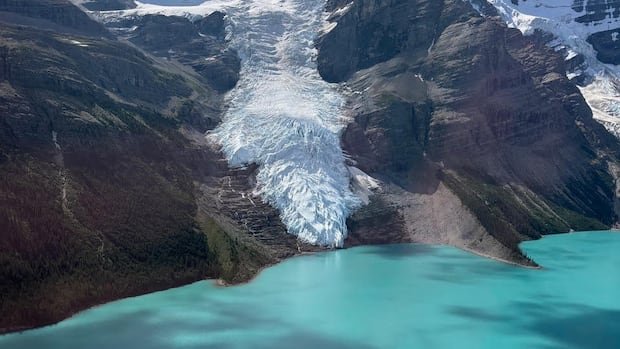
A significant transformation is occurring at Mount Robson in British Columbia, where researchers have discovered that the Berg Glacier no longer extends to touch Berg Lake. Joseph Shea, an associate geography professor at the University of Northern British Columbia (UNBC), observed this change during a field project, capturing a photo to document the glacier’s retreat.
The Berg Glacier, situated on the north face of Mount Robson, the highest peak in the Canadian Rockies near the Alberta border, used to reach Berg Lake. Ice chunks would break off from the glacier’s lower edge and fall into the lake, creating icebergs that floated on the turquoise waters, even in summer.
B.C. Parks, in collaboration with UNBC researcher Brian Menounos, has been monitoring the Berg Lake glacier and noted significant changes in recent years. The Berg Lake Trail, spanning 23 kilometers, is a popular destination for outdoor enthusiasts, with camping spots typically booking out quickly each summer.
Shea believes that the separation between the glacier and the lake will not impact the lake’s water levels significantly. However, it may reduce the number of icebergs calving into Berg Lake. Despite this change, Robson remains a stunning destination, maintaining its allure for visitors while serving as a poignant visual representation of climate change.
Research by UNBC’s Brian Menounos has revealed that glaciers in Western Canada and Switzerland lost 22% of their surface area between 1985 and 2021. Climate change-induced melting snow and ice caused severe damage to parts of the Berg Lake Trail during a record-breaking heatwave in 2021, necessitating evacuations and subsequent repairs.
Shea’s current work includes assisting B.C. Parks in establishing real-time weather stations to collect crucial data for park management, including snowpack, temperature, humidity, and precipitation. The implementation of these stations will support informed decision-making and visitor safety at Mount Robson Provincial Park.
The availability of real-time weather data is expected in late 2026, enabling park staff to proactively manage park operations and respond to potential hazards effectively. The ongoing efforts aim to enhance understanding of glacier changes and facilitate improved park management strategies in the face of climate change challenges.