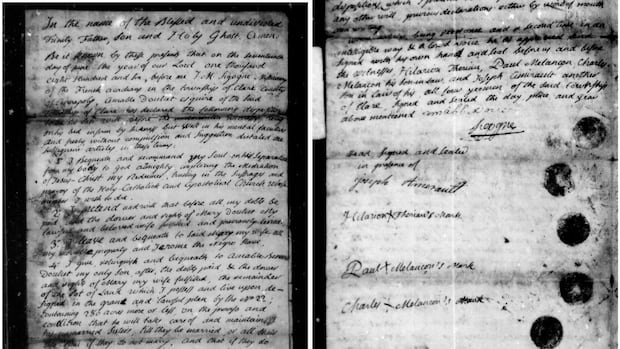
Hilarion Thériault, a 71-year-old Acadian, stood out in the 19th century for creating a will, a practice uncommon among his community due to the scarcity of property resulting from historic challenges. Following the Acadian deportation and restrictions on property ownership for Roman Catholics until the late 1700s, many Acadians faced difficulties in securing land titles despite residing and working on the land. However, Thériault defied the norm by ensuring his affairs were in order before his passing.
Colby Gaudet, a post-doctoral fellow at Dalhousie University, delved into Thériault’s will and 23 others from the Clare, N.S., Acadian community to explore how families navigated legal and religious customs in times of bereavement. Gaudet highlighted the blend of resistance and adherence in the wills, showcasing the Acadians’ incorporation of established Anglophone property norms while affirming their Roman Catholic identity.
Thériault’s will emphasized settling his debts, seeking reparations for any injustices, and promoting family harmony. The examination of these wills sheds light on the challenges Acadians faced in a society that marginalized them. Maurice Basque, a historian at l’Institut d’études acadiennes at the Université de Moncton, emphasized the historical context of social exclusion faced by Acadians, with the Crown seizing Acadian land and distributing it to settlers from New England as part of a broader plan to diminish the Acadian population.
The language barrier further complicated matters for the Acadians, as county judges overseeing wills were predominantly Anglo-Protestant, necessitating the drafting of wills in a foreign language. These wills were typically written by a priest, Jean-Mandé Sigogne, acting as a mediator between the Acadian families and the judicial system.
The wills analyzed by Gaudet predominantly belonged to community leaders who, like Thériault, held prominent roles within the parish, reflecting the deep integration of Catholicism into their lives. Despite societal disapproval, these wills honored Catholic traditions with specific references to religious figures such as the Virgin Mary and saints, distinguishing them from Protestant wills.
Moreover, the study of these wills unveiled insights into the relationships between Acadians and Black individuals. For instance, the will of Amable Doucet included the passing of a Black slave named Jerome to his wife, shedding light on the complex dynamics within Acadian communities. Another will mentioned the collaboration between Étienne Thibodeau, Paul Dugas, and Anselm Hatfield, a Black man from New York who had been an indentured servant and later lived as a free man in the community.
The research by Gaudet underscores the intricate historical and cultural dynamics embedded in these wills, offering a glimpse into the resilience and traditions of the Acadian community amidst challenging circumstances.