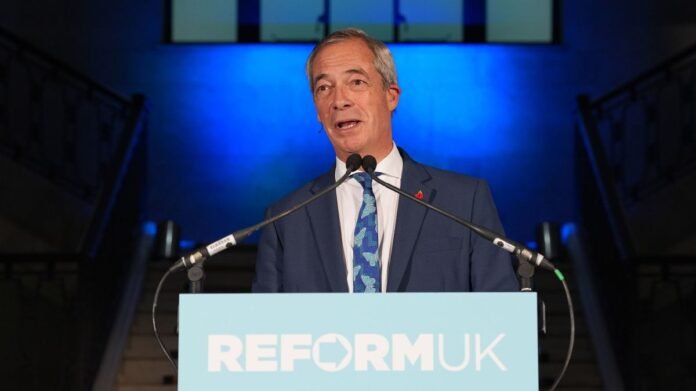
Nigel Farage has been criticized for proposing deeper cuts to public services than the Conservative Party, while also facing accusations of neglecting pensioners, with Reform labelled as “vultures” by detractors.
During a speech in the City of London, the leader of Reform UK announced a shift in tax pledges, opting for welfare reductions and a significant decrease in public spending if he comes to power. Farage expressed disappointment over missed Brexit opportunities, foreseeing a potential general election in 2027 due to economic instability.
Farage declined to commit to maintaining the pensions triple lock or preserving the current minimum wage for young workers. He reiterated his controversial plan to assist wealthy foreign magnates in evading taxes, drawing criticism for favoring financial speculators over the working class.
Critics accused Farage of presenting an inconsistent budget proposal that prioritizes hedge funds and speculators over ordinary workers. Lib Dem deputy leader Daisy Cooper condemned Farage’s intentions to compromise pensioners’ financial security to fund his policies, vowing to combat Reform’s actions to shield pensioners.
Farage acknowledged the challenges in implementing sweeping tax cuts amid the current economic conditions, conceding that significant reductions are not feasible at the moment due to mounting debt. He reaffirmed his plan to introduce a Britannia Card, allowing wealthy overseas individuals to evade taxes on foreign earnings and inheritance.
Additionally, Farage hinted at the possibility of lowering the minimum wage for young employees, citing concerns that the current rate may be excessive, especially after the reduction in the National Insurance Contributions threshold. Reform’s previous manifesto proposed substantial tax reductions, drawing skepticism from experts who deemed the financial projections unrealistic.
In response to Farage’s statements, TUC general secretary Paul Nowak criticized Reform’s austerity agenda, warning of severe consequences for public services, workers’ rights, and environmental standards. He accused Farage of prioritizing the interests of hedge funds and speculators over the welfare of working people, likening his economic strategy to the policies of former US President Trump.
Labour representatives expressed concerns over Farage’s proposed austerity measures, emphasizing the potential harm to essential services like the NHS, schools, and pensions. They criticized Reform’s agenda as detrimental to public investments in infrastructure and clean energy, jeopardizing millions of jobs and families’ financial stability.
During his address, Farage accused the government of hindering business growth and advocated for a tax system that encourages high earners to remain in the country. He predicted an impending general election triggered by economic turmoil, foreseeing a shift towards austerity measures in the near future.
Tory Shadow Chancellor Sir Mel Stride denounced Reform’s economic strategy as chaotic, pointing out the lack of funding for promises and the reckless seizure of private assets. He criticized Farage for failing to provide a coherent plan for the country’s economic recovery, labeling the proposals as disruptive rather than constructive.