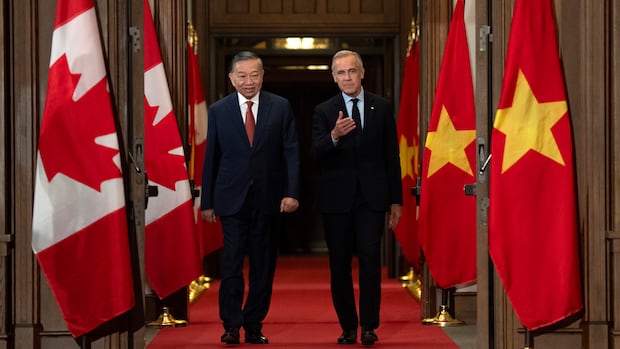
Vietnamese President Tô Lâm has established a strategic partnership with Canada, enhancing the collaborative efforts initiated by Prime Minister Mark Carney aimed at strengthening ties among middle powers to counteract the pressures from the United States and China.
“In an unpredictable world, trust, accountability, and shared interests are inherently strategic values,” Lâm stated Thursday through an interpreter during his address at Parliament Hill.
The state visit, which lasted a single day, included several activities, such as planting a tree at Rideau Hall and addressing members of parliament and the Vietnamese community abroad.
Lâm marks the first Vietnamese president to visit Canada and holds the position of leader of the country’s communist party, making him the most influential figure in Vietnam.
During a meeting in Carney’s West Block office, the prime minister praised Lâm for his leadership among middle powers, noting how swiftly the relationship has developed since a 2017 agreement addressing investment, defense, and academic collaboration.
“Travelers wishing to fly directly from Canada to Vietnam and back will have good news soon,” Carney mentioned, hinting at the possibility of direct commercial flights.
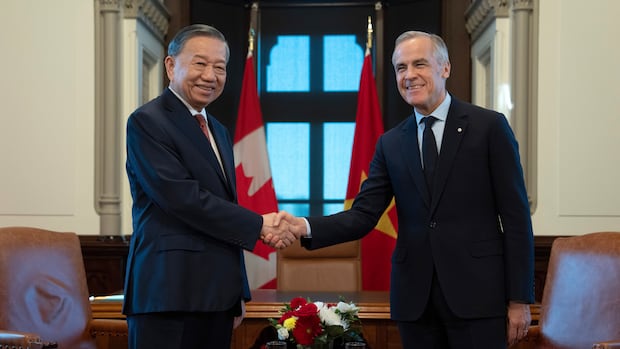
Prime Minister Mark Carney states that Canada and Vietnam ‘will strike agreements on a number of areas’ including energy, agriculture, and defense co-operation. ‘There will be good news for people who want to travel directly from Canada to Vietnam,’ Carney announced while welcoming Vietnamese leader Tô Lâm — who serves concurrently as the president and the first general secretary of Vietnam’s Communist Party.
The establishment of this strategic partnership indicates a commitment to enhancing cooperation on long-term objectives, according to Vina Nadjibulla, co-founder of the Centre for Strategic Statecraft, a geopolitical think tank.
“We find ourselves at a juncture where the relationship can advance to new heights, and there’s undoubtedly political will from both nations,” she commented.
Nadjibulla explained that despite Vietnam being a communist nation, it is trade-oriented — similar to Canada — and aims to uphold the rules-based international framework while seeking to diversify its economy.
“Although the leadership styles differ significantly from Canada, Vietnam’s current direction aligns closely with Canada’s goals of enhancing resilience, diversifying partnerships, and exercising greater autonomy to avoid domination by any one nation,” she added.
A comprehensive partnership
Foreign Affairs Minister Anita Anand mentioned that the renewed partnership will focus on energy, agriculture, defense collaboration, and fostering people-to-people connections. She emphasized that Canadian universities and investors can play a crucial role in supporting Vietnam’s transition from economic development to an innovation-driven economy.
“As the global economy evolves, our strategy is not to retreat but to forge partnerships,” she affirmed.
Lâm pointed out that these partnerships should encompass Canadian technology, especially in sectors such as agriculture, clean energy, and education.
“It is essential to maintain consistent exchanges and interactions, particularly at high levels, early on — and to do so candidly — regarding changes that may impact both parties’ interests,” he remarked.
Lâm urged for “concrete action programs with defined priorities” aimed at addressing existing “bottlenecks.”
According to Global Affairs Canada’s online profile, Vietnam is Canada’s largest trading partner in Southeast Asia, with bilateral merchandise trade exceeding $20 billion last year. Canada primarily exports food, metal, and fertilizers, while Vietnam sells electronics, clothing, furniture, and footwear.
“Vietnam is a significant economic partner instrumental in furthering Canada’s trade diversification strategies in the region,” stated the department.
Vietnam is also a participant in the Association of Southeast Asian Nations (ASEAN), with which Canada is in discussions to establish a free-trade agreement. Carney aims to finalize that agreement during a scheduled visit to the Philippines in November, which may also include a stop in Vietnam.
Mitigating U.S. reliance
Nadjibulla explained that Vietnam enjoys a substantial trade surplus with various countries, including Canada, partly due to U.S. President Donald Trump’s first term, which promoted trade with Asian nations outside of China. This shift resulted in a surge in Vietnamese electronics production.
“We import significantly from Vietnam while exporting relatively little,” she noted, asserting that Canadian firms have not fully capitalized on opportunities in this nation of 100 million people.
Currently, Vietnam is contending with significant American tariffs and is pursuing a bilateral agreement with Washington while striving to expand its trade networks beyond the U.S.
“This alignment between Canada and Vietnam comes from our mutual efforts to diversify supply chains and reduce excessive dependence on the U.S.,” Nadjibulla commented.
Furthermore, Vietnam is at the forefront of U.S. initiatives to eliminate forced labor from supply chains, particularly those potentially associated with Uyghur forced labor in China’s Xinjiang region.
Concerns have also been raised by Canada’s former corporate ombudsperson regarding running shoes made in Vietnam, warning they may contain cotton sourced from forced labor.
Beijing has dismissed the Trump administration’s allegations about forced labor as baseless and argues they are intended to undermine China’s economic growth. Vietnam has expressed that it takes Washington’s concerns seriously.
Strengthening middle power alliances
This year, Vietnam is in charge of the rotating presidency of the Comprehensive and Progressive Agreement for Trans-Pacific Partnership (CPTPP), a trade bloc comprising various nations, including Canada, Chile, Japan, and Australia, that adhere to rules-based commerce and fundamental workers’ rights.
The CPTPP bloc has grown increasingly crucial as nations face economic coercion, such as China restricting supply chains for essential minerals and Trump imposing tariffs under dubious pretexts.
Lâm has endorsed Carney’s nascent initiative to encourage closer collaboration between the European Union and the CPTPP bloc, allowing middle powers to unite against coercive tactics.
-
Carney’s Davos speech draws reaction from around the world
-
Carney says Europe, Canada aren’t ‘fair-weather allies’ while rebuking Trump’s tactics
“This has made their relationship even more significant this year, given the international context,” Nadjibulla stated.
Canada has provided aid to Vietnam for decades and did not participate in the U.S. conflict during the 1970s. Canadians helped resettle over 60,000 Indochinese refugees through initiatives like private sponsorships.
In his speech, Lâm reflected on this history, expressing that Vietnam values its independence while striving for peaceful relations with rival powers.
He described Canada as a “vast, beautiful country filled with vitality” — one that Vietnam remembers for its contributions to landmine clearance, peacekeeping efforts, and ozone layer protection.
Nadjibulla noted that this visit aligns with a broader trend of foreign leaders engaging with Canada in response to Carney’s initiatives to enhance trade and diplomatic relations.
Recent visits have also included leaders from the Philippines and Norway, and Carney has confirmed a planned December visit by Indian Prime Minister Narendra Modi.
“The fact that diplomacy at the leader level is occurring is indicative of Canada’s increasing role as a middle power on the international stage,” Nadjibulla concluded.
Tag: rewrite-pending