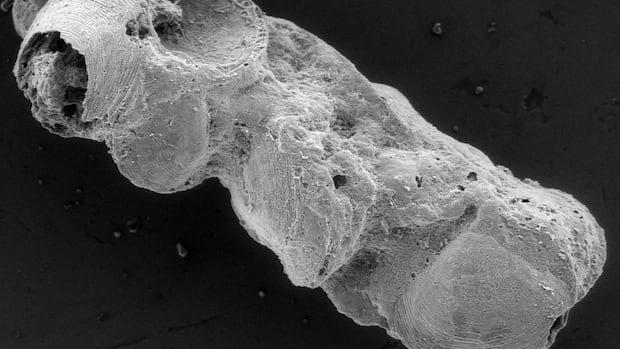
In the ancient past, prior to the era of dinosaurs, there was a surge in biodiversity leading to the evolution of early ancestors of present-day creatures, accompanied by a rise in excrement. While not a widely-discussed aspect of paleontology, a recent study has brought attention to how the examination of coprolites, or fossilized feces, aids in comprehending the ecosystems of early Earth, nutrient cycles, and current animal relationships.
Published in Trends in Evolution & Ecology, the study delved into the analysis of fecal fossils dating back to the Cambrian period, which commenced approximately 540 million years ago. By scrutinizing fecal remains from ancient worms, invertebrates, and mollusk-like organisms, scientists determined that fecal matter likely played a role in enhancing the habitability of deep water ecosystems and the availability of nutrients during that epoch, long before the existence of dinosaurs.
The substantial presence of feces during the Cambrian period, as revealed by the study, holds significance for unraveling the origins of contemporary marine ecosystems. Julien Kimmig, a co-author of the study and head of the paleontology division at the Karlsruhe Natural History Museum in Germany, emphasized the importance of recognizing the role of feces in sustaining both past and present ecosystems and potentially influencing evolution.
The research conducted by Kimmig and Russell Bicknell involved the analysis of numerous coprolites from various deposits worldwide, shedding light on the behavior of different organisms such as burrowing worms, arthropods, brachiopods, and hyoliths. These coprolites, ranging from microscopic to the size of rabbit droppings and containing shell or worm fragments, offer insights into evolutionary patterns, dietary habits of ancient creatures, and the dynamics of ancient ecosystems.
Studying coprolites not only aids in understanding the past but also holds relevance for comprehending modern ecological systems. By examining coprolites, researchers can gain insights into how past ecosystems adapted to environmental changes, thereby providing valuable lessons for predicting and modeling future ecological scenarios. The study of coprolites adds a new dimension to paleontological research, offering a deeper understanding of ancient life forms and their interactions, which can inform our understanding of current and future ecological trends.
In the realm of paleontology, the study of coprolites during the Cambrian period enriches our comprehension of one of Earth’s most intriguing eras. The Cambrian Radiation, which occurred around 520 to 540 million years ago, marked the emergence of fossil records of organisms closely related to contemporary animals, signifying a pivotal moment in the diversification of life on Earth. Understanding this period is crucial for tracing the origins of modern oceanic ecosystems and gaining insights into the processes that have shaped biodiversity over millions of years.
The study underscores a notable increase in fecal matter during the Cambrian Radiation compared to the preceding Ediacaran period, pointing to a significant shift in ecological dynamics during that era. By examining waste products and their impact on nutrient cycles, energy flow, and biological diversity, researchers can unravel the intricate interplay between organisms and their environments, offering valuable lessons for understanding and predicting future environmental changes.
For certain paleontologists, coprolites have become a focal point of research, offering unique perspectives on ancient ecosystems and interactions among organisms. Karen Chin, a curator at the Museum of Natural History and professor at the University of Colorado, emphasizes the importance of coprolites in uncovering not just the biology but also the ecological relationships of ancient life forms. Through coprolite analysis, researchers can decipher intricate food webs, carbon cycles, and ecological adaptations, providing crucial insights into the functioning of ancient ecosystems and their relevance to contemporary and future environmental challenges.
By studying coprolites, researchers can glean unexpected revelations about the diets and behaviors of prehistoric creatures, offering a window into the ancient world that is often shrouded in mystery. These fossilized feces, though less glamorous than traditional fossils, hold immense potential for enhancing our understanding of past ecosystems and shedding light on the complex interactions that have shaped life on Earth over millions of years.