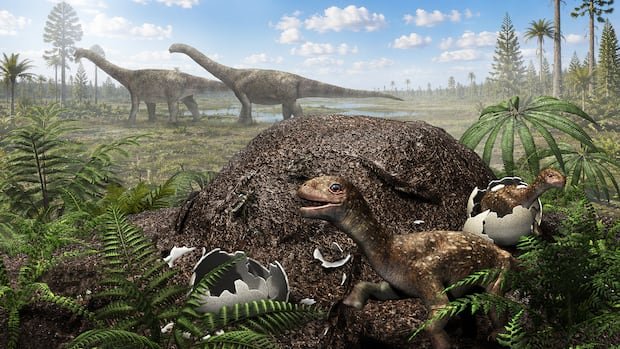
Fossil eggshells believed to belong to some of the largest dinosaurs ever discovered have been unearthed in a surprisingly cool climate, distant from the equator. Despite the colossal size of titanosaurs, they did not rely on brooding to keep their volleyball-sized eggs warm.
A recent study, co-authored by University of Calgary paleontologist Darla Zelenitsky, in collaboration with researchers from Japan and Argentina, delved into the microscopic details of titanosaurs’ eggshells to uncover their incubation method. By examining the tiny pores on the eggshells, the team concluded that titanosaurs likely adopted a technique similar to modern crocodiles – burying their eggs in warm composting vegetation to maintain the necessary warmth for hatching.
Titanosaurs, massive herbivorous dinosaurs weighing up to 75 tonnes and resembling long-necked giants, roamed the Earth during the Late Cretaceous period. The discovery of volleyball-sized fossil eggs associated with titanosaurs, known as Fusioolithus, sheds light on their reproductive habits. Fragments of Fusioolithus eggshells found in the Chorrillo Formation in southern Argentina, dating back 72 to 66 million years, reveal a diverse ecosystem teeming with various dinosaur species and other fauna.
Despite the challenging environment, titanosaurs managed to thrive in higher latitudes, far from the equator, showcasing their remarkable adaptability. The researchers’ analysis of the porous nature of the titanosaurs’ eggshells from the Chorrillo Formation suggests that these eggs were buried for incubation, ensuring the embryos’ survival in cooler climates.
The study highlights the ingenuity of dinosaurs in adapting to different environments for reproduction. Tsu-Ruei Yang, an expert in vertebrate paleontology, suggests that the diverse nesting strategies of titanosaurs might have contributed to their global spread during the Late Cretaceous era. Further research into titanosaur nesting behaviors could provide valuable insights into their evolutionary success.
Overall, the findings underscore the resourcefulness and survival skills of titanosaurs, shedding new light on their reproductive strategies in diverse climatic conditions.