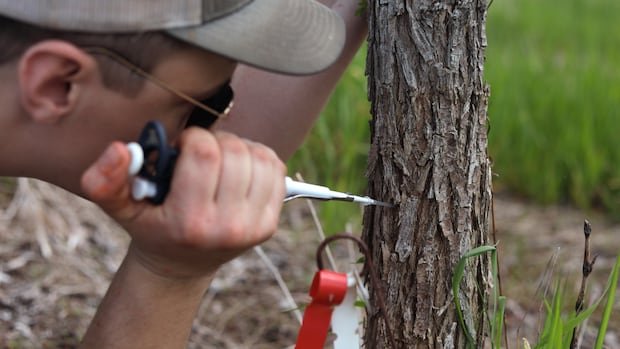
During the summer, scientists in Vermont deliberately infected thousands of trees with Dutch elm disease as part of an experiment. The aim is to develop a new generation of elms that are resistant to the disease that has been devastating elm populations in the U.S. and Canada for many years. Researchers from the U.S. Forest Service and the Nature Conservancy are behind this initiative, hoping to restore areas where elms once thrived.
Gus Goodwin from The Nature Conservancy expressed how the loss of elm trees over the years has been tragic. The experiment in Vermont is being closely monitored to see if it will yield a strain of elms that can resist Dutch elm disease. Similar efforts are also underway in Canada to combat the disease’s growing threat.
Fredericton, once known as the “City of Stately Elms,” saw a drastic decline in its elm population due to the disease in the 1960s and 70s. The situation remains concerning, with only about 1,000 mature elms left standing in the city. Anthony Taylor, a forest management professor, shared his disappointment as he witnessed another wave of the disease affecting trees on his property.
Dutch elm disease spreads through bark beetles, which infect elms with a fungus that blocks their water-conducting tissue, leading to the tree’s death within a few years. Efforts to control the disease involve promptly removing infected trees to prevent further spread. In the past, healthy elms were also removed as a preventive measure, potentially impacting the overall resilience of the elm population.
Urban areas across Canada are facing new challenges with Dutch elm disease affecting mature elms. Edmonton and Saskatoon have reported cases of infected trees, prompting swift action from city authorities to contain the spread. Experts emphasize the importance of community involvement in protecting elm trees and preserving urban forests.
Despite the ongoing battle against Dutch elm disease, there is hope for developing disease-resistant elms through breeding programs. Projects in Guelph and Fredericton have been working on enhancing the resilience of elms against the disease for decades. The long-term goal is to reintroduce disease-resistant elms into communities, contributing to biodiversity and environmental adaptation.
While the process of developing disease-resistant elms is time-consuming, researchers are optimistic about the potential outcomes. If successful, these efforts could lead to a coexistence between elms and Dutch elm disease, similar to the situation in Europe. The journey towards restoring elm populations in North America continues, with a focus on sustainability and environmental preservation.
Tag: rewrite-pending