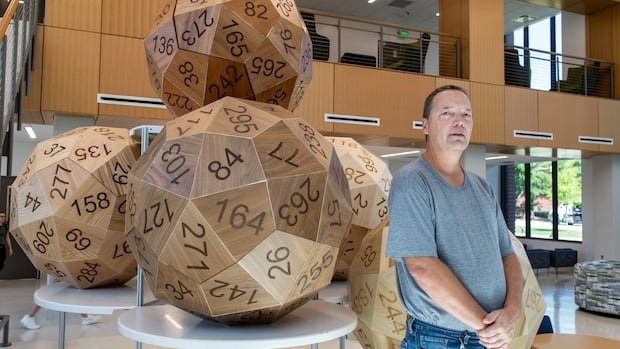
A mathematician, Eric Harshbarger, was presented with a challenge at a gaming convention in 2012 to create a set of dice that could determine the starting player in a board game without the possibility of a tie. The aim was to expedite the game’s beginning and allow players to dive into gameplay swiftly.
Harshbarger, a senior lecturer at Auburn University in Auburn, Alabama, found the problem intriguing as it lacked an obvious solution, which typically entices mathematicians. He devised a theoretical solution involving dice that could ensure a fair outcome for all players without any ties.
Despite the theoretical concept, developing functional dice proved to be a complex task. After nearly 15 years of collaborative efforts with around 20 computer scientists and mathematicians worldwide, Harshbarger and his team successfully created a set of Go First Dice specifically designed for five players. These dice guarantee a decisive winner from a single roll, resolving the issue of determining the starting player fairly.
The journey to creating these specialized dice involved various iterations and collaborations. The team experimented with different dice designs, eventually settling on a set of twelve-sided dice for two, three, and four players. However, devising a solution for five players proved to be more challenging.
Through persistent efforts and collaboration, the team eventually settled on a set of five 120-sided dice, ensuring a fair outcome for all players. The development process attracted attention globally, with researchers like Canadian software engineer Paul Meyer contributing to the project’s success.
Meyer’s computational approach, employing mathematical patterns and intensive computer searches, led to a breakthrough using five 60-sided dice. The dice, now available for purchase, are designed to be perfectly fair based on solid mathematical principles.
The research continues, with ongoing investigations into whether fewer sides could be feasible for a five-player set and the potential expansion to accommodate six players. Harshbarger acknowledges the unpredictable nature of the problem but remains committed to exploring new theories and solutions to further enhance the fairness and efficiency of the dice in board game settings.