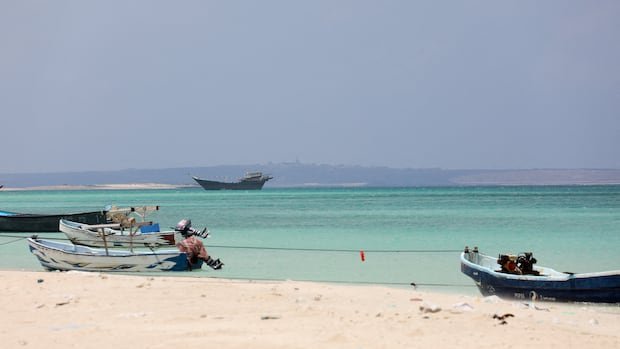
Yemeni officials reported that six individuals lost their lives on Tuesday due to an assault by Iran-backed Houthi insurgents on a vessel in the Bab el-Mandeb strait. Among the deceased were four crew members and two members of the government-aligned National Resistance Forces. According to Yemen’s Transportation Ministry, the Houthis launched three ballistic missiles at the Yemeni commercial ship.
This incident marks the first recorded fatalities resulting from Houthi assaults on maritime vessels in Yemen during the recent surge of conflict in the region. As the Strait of Hormuz remains effectively closed off by Iran, attention has shifted to the Red Sea and the Bab el-Mandeb Strait at the southern tip of Yemen, serving as an alternative route for Saudi Arabia’s oil shipments.
The Houthi rebels also targeted the government-controlled port city of Mokha on the Red Sea and other locations within the country. Yemen’s military confirmed that the rebels carried out missile and drone attacks on Mokha and the central province of Marib, resulting in casualties. The previous week, the Houthis struck Marib and the eastern province of Hadramout, causing fatalities among government troops and civilians. Additionally, Mokha, a key port under Yemen’s internationally recognized government, was hit, leading to multiple casualties.
These attacks represent an escalation by the Houthis against Yemeni government forces and oil installations in Saudi Arabia, a supporter of the internationally recognized Yemeni government. The repercussions of the Houthi assaults could potentially reignite Yemen’s civil conflict following a truce in 2022, creating a new front in the broader Middle East conflict.
Mohammed Abdul-Salam, the chief negotiator and spokesperson for the Houthis, accused Saudi Arabia of exploiting the ceasefire to enforce a blockade imposed since 2015. While expressing readiness for negotiations, Abdul-Salam emphasized that any resolution must include the lifting of the blockade, a claim that Riyadh denies.
The increase in attacks on vessels in the Bab el-Mandeb Strait has heightened uncertainty for shipping companies already grappling with the closure of the Strait of Hormuz. Meanwhile, Iranian Foreign Minister Abbas Araghchi emphasized Iran’s steadfast demands, insisting on the cessation of the U.S. blockade of Iranian ports, the lifting of sanctions on Iran, and other conditions before considering reopening the Strait of Hormuz.
The closure of the strait following attacks by Israel and the U.S. has disrupted global oil trade, influencing energy prices significantly and becoming a focal point of U.S. political discourse leading up to the upcoming midterm elections. President Donald Trump remarked that the U.S. Navy’s blockade has effectively restricted Iran’s oil sales on the international market, impacting the Iranian economy despite potential disruptions caused by Iran in the region.