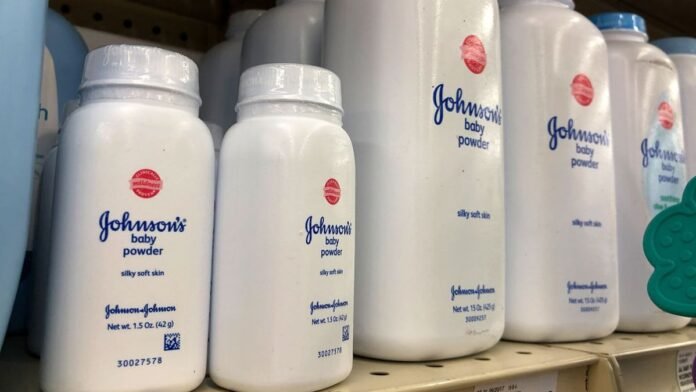
Thousands of individuals are pursuing legal action against Johnson & Johnson, alleging that their talcum powder usage led to cancer development.
Approximately 3,000 people in the UK have filed lawsuits against the pharmaceutical company, claiming that Johnson’s Baby Powder was knowingly sold contaminated with asbestos. The claimants argue that either they or their family members contracted ovarian cancer or mesothelioma from using the talcum powder. Seeking compensation, they are taking their case to the High Court in London.
One of the individuals involved in the lawsuit, Janet Fuschillo, shared her experience, stating that she had been using J&J’s baby powder since the 1960s and was diagnosed with ovarian cancer seven years ago.
Janet, aged 75, expressed her distress, saying, “I used talc on myself and all four of my children because we were informed it was pure and beneficial. I applied talc during nappy changes, after baths, consistently for nearly five decades. It is troubling and infuriating to think that I used talc on my children.”
Legal representatives for the group highlighted in court documents that Johnson & Johnson had “concealed” the risks associated with their talcum powder for many years. The company has since replaced talc with corn starch in its baby powder in the UK starting from 2023. KP Law is handling the case against Johnson & Johnson, the leading distributor of talcum powder.
Contrary to the allegations, a spokesperson for Kenvue, previously associated with Johnson & Johnson, affirmed that the talc used in baby powder adhered to regulations, was asbestos-free, and did not induce cancer. Talc is a natural mineral extracted from the earth.
Michael Rawlinson KC, representing the claimants, stated in court filings that most commercially exploited talc deposits across the globe contain asbestos, including those supplying Johnson & Johnson. He asserted that information from these mines, in addition to existing scientific research, should have informed Johnson & Johnson about asbestos contamination.
Despite this knowledge, the company allegedly withheld information indicating asbestos contamination in their baby powder. Mr. Rawlinson accused Johnson & Johnson of acting in bad faith to safeguard their product’s reputation and profits, neglecting the health risks associated with their talcum powder.
Mesothelioma, a cancer type predominantly linked to asbestos exposure, typically forms in the lungs when individuals inhale microscopic asbestos fibers, as outlined by the NHS.
Patricia Angell recounted the tragic loss of her husband Edward, who succumbed to mesothelioma in 2006 at the age of 64, despite being a fit electrician knowledgeable about asbestos. She emphasized that talcum powder usage was a routine for her husband, assuming it was safe. Edward’s autopsy report mentioned talc and asbestos strains found in contaminated talcum powder.
She lamented the years of life Edward lost and the absence of a father figure for her children. Mr. Rawlinson highlighted that the application method of baby powder, whether squeezed or shaken, dispersed powder particles in the air, facilitating inhalation.
In a separate legal case, a US jury previously ordered Johnson & Johnson to pay $4.69 billion in damages to 22 women who claimed to have developed ovarian cancer due to Johnson’s baby powder.
Responding to the allegations, a Kenvue spokesperson expressed sympathy for cancer patients and emphasized the rigorous testing conducted by independent laboratories, universities, and health authorities worldwide, confirming the safety of Johnson’s Baby Powder.
A Johnson & Johnson spokeswoman redirected inquiries to Kenvue, the former consumer health division, emphasizing the separation from Johnson & Johnson in August 2023. Kenvue retained the responsibility and potential liability regarding talcum powder litigation beyond the US and Canada.