
On Monday, Russia’s Defence Ministry reported that it intercepted 1,336 Ukrainian drones, marking the highest number of downed aerial threats since the onset of Moscow’s comprehensive invasion of Ukraine nearly five years ago.
In recent months, Ukraine has intensified its long-range drone strikes against Russia, targeting the illegally annexed Crimea Peninsula, as well as the Black and Azov seas, deploying over 1,000 drones in certain daily operations.
Conversely, Russia has continued its aggressive assault on Ukrainian civilian areas, conducting relentless strikes aimed at crippling the economy and undermining public morale, particularly through attacks on the power infrastructure.
Efforts to mediate talks through U.S. involvement have yet to yield any positive outcomes in the ongoing conflict. U.S. President Donald Trump’s representatives, Jared Kushner and Steve Witkoff, expressed hopes to facilitate further negotiations between Moscow and Kyiv following last week’s discussions, although no specific date has been announced.
According to Western analysts and officials, the war has resulted in the deaths of hundreds of thousands of soldiers and thousands of Ukrainian civilians.
Trump indicated his intention to address the war in an upcoming meeting this week in China with Chinese President Xi Jinping and Russian President Vladimir Putin.
European Union nations have accused Russia of attempting to prolong the negotiation process to resolve the conflict. The EU has imposed sanctions on nearly 50 Russian banks and financial institutions, as well as targeting several individuals associated with the energy sector.
Kerch Bridge targeted
Ukraine has aimed at the Kerch Bridge, a crucial link for transporting military and civilian supplies from Russia to Crimea, which also symbolizes Russia’s illegal annexation of the peninsula in 2014. Kremlin spokesperson Dmitry Peskov claimed that the attack resulted in “insignificant damage,” and authorities managing the bridge announced that vehicular traffic resumed by Monday evening.
Local authorities reported that six individuals were injured in an attack within Russia’s southern Krasnodar region, which houses the Ilsky oil refinery, frequently targeted by Ukrainian drone strikes.
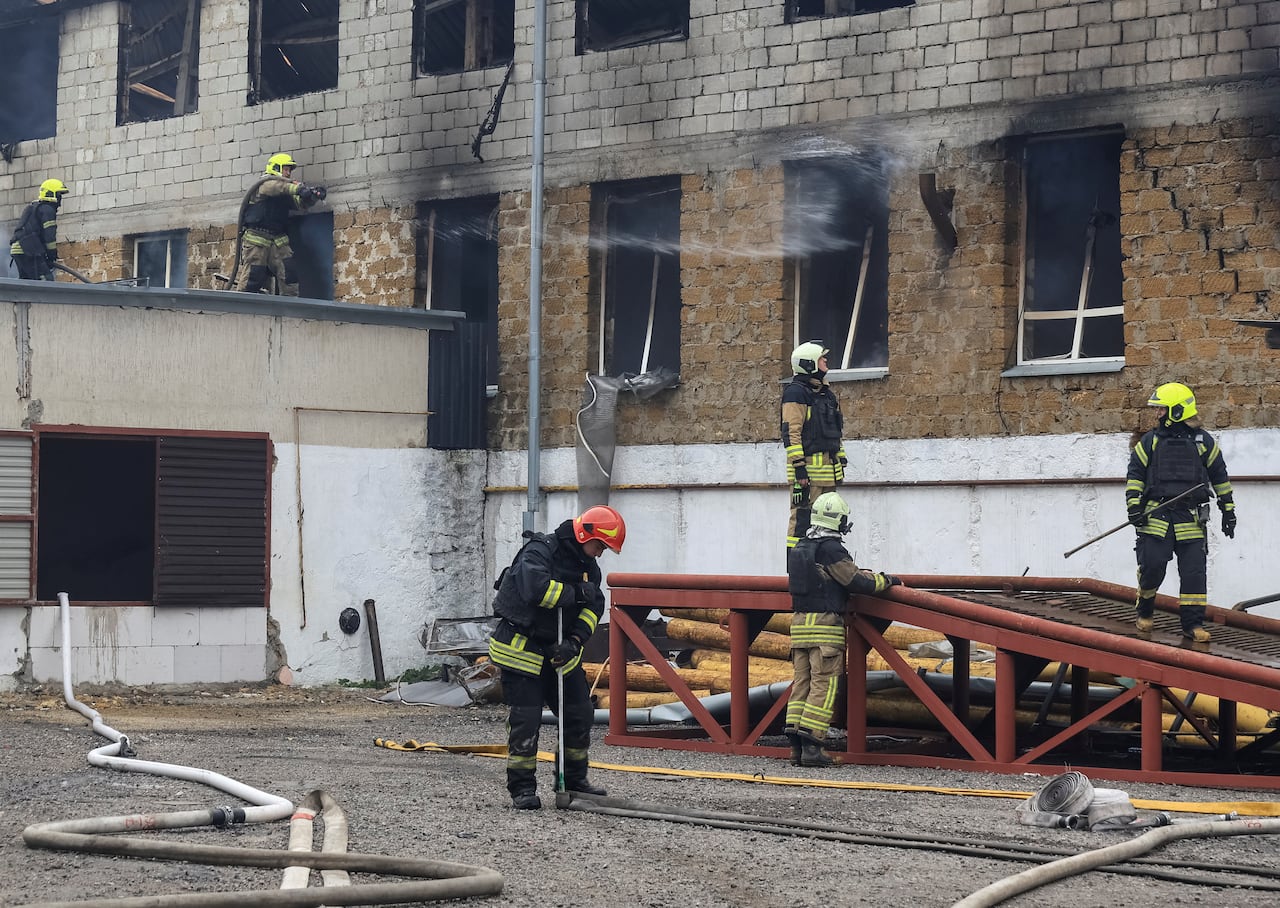
Firefighters work at the site of a cardboard factory hit by a Russian jet drone attack Monday, in Odesa, Ukraine. (Nina Liashonok/Reuters)
In the Rostov region, near the Ukrainian border, Governor Yuri Slyusar reported that three individuals in the city of Azov were injured as a result of drone attacks.
Mayor Sergei Sobyanin stated that approximately 600 drones targeted the Moscow region overnight, with most being downed away from the capital. He reported that 191 drones were shot down as they neared Moscow.
Ukraine pushes back with long-range strikes
Ukraine’s long-range operations have frequently struck Russian oil refineries, which are vital to Moscow’s economy. Ukrainian President Volodymyr Zelenskyy announced on Sunday night that these attacks have incapacitated more than 55 percent of Russia’s oil refining capabilities.
Russian officials have not responded to this assertion, and independent verification remains elusive. However, on October 1, Putin acknowledged the strikes’ economic toll, estimating a loss of about one percent of Russia’s gross domestic product.
Analysts suggest that Ukrainian officials are also intent on making the war felt domestically in Russia, while mid-range strikes disrupt supply routes at the front lines and hinder Moscow’s ability to gain traction in the conflict.
-
U.S. envoys talk to Zelenskyy in Dublin, after prior sitdown with Putin in Moscow
-
Russia-Ukraine talks mediated by U.S. end with news of ‘good momentum,’ large-scale prisoner swap
Kyiv has expressed concerns that newly implemented speed restrictions on the U.S.-manufactured Starshield system, SpaceX’s military-enhanced version of the Starlink satellite service, have diminished Ukraine’s air defense capabilities. In response, Ukrainian forces are reportedly launching pre-emptive strikes against Russian arms manufacturing facilities and drone and missile launch sites.
Kyiv also aims to reassure its allies that it remains committed to the fight, as Moscow attempts to portray its victory in Ukraine as inevitable.
The extent of damage inflicted by Ukrainian strikes within Russia remains unclear, as authorities in Moscow and local officials seldom share specific details.
Zelenskyy calls Russian strikes ‘brutal’
As the conflict continues, Ukrainians are preparing for what could be the most challenging winter since the war commenced, with Russia persistently attacking the power grid and depriving civilians of heat, light, and running water.
Ukrainian Prime Minister Serhii Koretskyi reported on Monday that Russian strikes on power lines and substations in the southern Zaporizhzhia and central Dnipropetrovsk regions have left hundreds of thousands without electricity.
Zelenskyy stated that Russia’s strategy involves bombarding specific locations for extended periods, systematically destroying energy infrastructure.
Since early September, the central Dnipro region has suffered 131 strikes, while the Kyiv region surrounding the capital has experienced 125, he added.
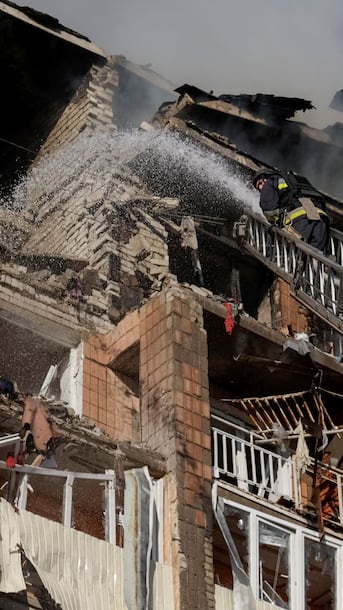
Ukrainian President Volodymyr Zelenskyy stated that Russia violated an ‘energy ceasefire’ declared by U.S. President Donald Trump on October 11 via a social media announcement. The post includes few details, aside from indicating that the truce is ‘effective immediately.’ Ukrainian officials report that residents in Kharkiv and Kyiv are currently without heat and hot water due to Russia’s drone strikes on power and gas facilities.
Local officials stated that one person was killed and three others injured in a Monday attack in Dnipro, while another individual lost their life and four were injured in the northeastern Kharkiv region due to a strike.
Zelenskyy noted that over the past week, Russia has launched upwards of 2,300 drones, along with 1,590 glide bombs and 15 missiles against Ukraine.
He described these as “brutal strikes that are difficult to counter,” in a social media update.
In the past day, Russian shelling of towns and villages in the Donetsk region resulted in four fatalities and three injuries, reported Vadym Filashkin, the head of the Donetsk Regional Military Administration.