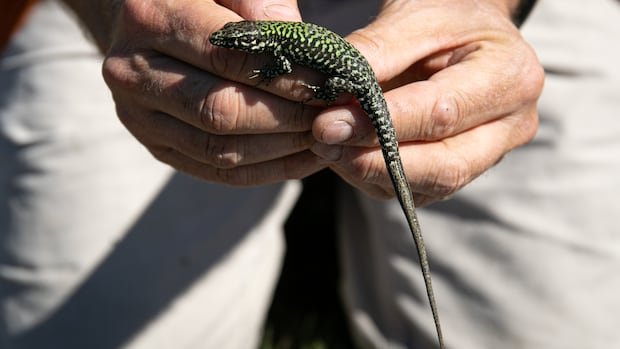
Tracy Menzies previously faced a persistent slug problem in her backyard garden, but this year, she successfully protected her strawberries from the pests. The reason behind the slugs’ decline in her garden is attributed to the presence of the invasive European wall lizard. These lizards, known for their rapid spread and voracious appetite, have been observed preying on various creatures, including slugs.
Living near the Gorge Waterway in Saanich, Menzies noticed a surge in the number of wall lizards in her yard recently. She believes that these lizards are likely feasting on the slugs, as she no longer finds slugs in her garden. Described as small creatures, some of these lizards can grow up to eight to ten inches, and they have been spotted in crawl spaces as well.
Gavin Hanke, the curator of vertebrate zoology at the Royal B.C. Museum, estimates that there are around 800,000 to a million European wall lizards in British Columbia, primarily concentrated on Vancouver Island. Their rapid proliferation raises concerns about their environmental impact, especially on native species. Despite the challenges posed by these invasive lizards, Hanke emphasizes the need to adapt and coexist with them.
Biologist Nicholas Wong from the Invasive Species Council of B.C. highlights the lack of official management programs to control the wall lizard population growth. Wong notes that these lizards compete with native species for resources and territory. Hanke, a Victoria resident, has personally witnessed a significant increase in the number of wall lizards in his own yard over the years.
The proliferation of European wall lizards in British Columbia can be traced back to a deliberate release of 12 lizards in 1970 following the closure of Rudy’s Pet Park in Central Saanich. The favorable climate conditions on Southern Vancouver Island have facilitated the lizards’ establishment and expansion. Their spread is primarily facilitated through natural movements and unintentional transportation by humans.
These omnivorous lizards consume a variety of insects, spiders, and invertebrates, as well as certain fruits. While they have offered some benefits, such as controlling pests like slugs, concerns about their unchecked spread remain. Strategies to mitigate their impact include maintaining unappealing habitats for the lizards and fostering collective efforts within communities to address the issue.
Hanke acknowledges that eradicating the European wall lizards at this stage is unfeasible, considering their widespread presence. He emphasizes the role of human activity in facilitating the introduction and proliferation of these invasive species. Hanke warns against relocating these lizards, as it could lead to further expansion of their range to new regions.


