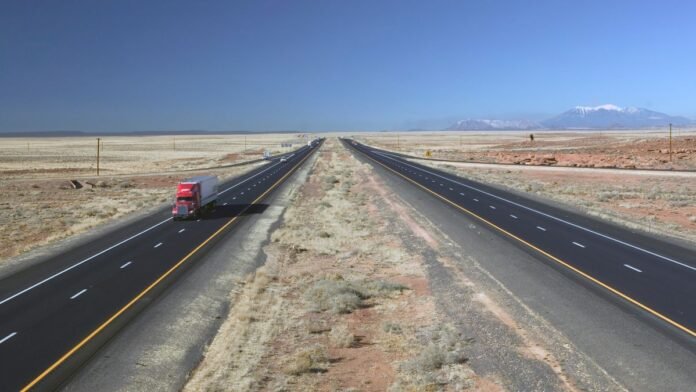
A man recently shared eerie revelations about the secrets surrounding a notorious road known for a series of unsolved murders. Through a TikTok video filmed while driving along Interstate 40, he reignited interest in a troubling issue that has puzzled the FBI for nearly two decades – a pattern of bodies discovered off major US highways, particularly in remote pull-offs and truck-stop areas, dating back to the 1980s.
The FBI’s database highlights numerous victims whose deaths are believed to be linked to highly mobile criminals utilizing interstates to prey on individuals and evade detection across state borders. The bureau acknowledges that the number of suspects under scrutiny also reaches the hundreds, with figures constantly changing as new cases emerge.
In 2004, investigators in Oklahoma brought attention to a concerning cluster of murdered women found along the I-40 corridor, leading to the escalation of the FBI’s Highway Serial Killings Initiative. This nationwide program, stemming from the long-established Violent Criminal Apprehension Program (ViCAP) launched in 1985, aims to identify connections between homicides occurring in proximity to major roadways.
ViCAP analysis revealed a disturbing trend of victims, often vulnerable women, being disposed of in similar locations across multiple states, frequently along interstate highways commonly used by long-distance travelers. Official data and FBI-led briefings indicate a significant number of homicide victims cataloged in the national highway-killings dataset, with reports suggesting that the broader pool of highway-related killings spanning four decades could exceed 850 cases, many of which remain unresolved.
Authorities clarify that the figure represents cases necessitating further investigation rather than confirmed instances of serial killers. Numerous potential suspects have been identified through submissions from law enforcement agencies nationwide, although many are considered “persons of interest” rather than proven offenders.
Despite the somber reality, the initiative has achieved notable successes. By utilizing ViCAP, analysts have linked seemingly isolated cases, connecting numerous murders to single perpetrators whose actions only became coherent when mapped against interstate routes. In some instances, analysts matched a killer’s travel patterns with dump sites hundreds of miles apart, prompting the reopening of cold cases by local authorities and the identification of long-missing victims.
The mobility of offenders enables them to cross state lines, discard bodies in unfamiliar jurisdictions, and leave a trail of evidence that may take years to piece together. The challenge of identifying victims is compounded by their lack of strong ties to the areas where they are found and the delayed reporting of their disappearances, making timeline reconstructions arduous.
Travelers along I-40, a transcontinental road spanning from North Carolina to California, are well acquainted with the highway’s notorious reputation. The TikTok video shared by user @nomadsanimalencounter captures the driver’s unease while traversing desolate stretches where numerous bodies have historically been discovered.
While I-40 has been a focal point for various high-profile clusters, the issue extends beyond to other highways across the United States.

