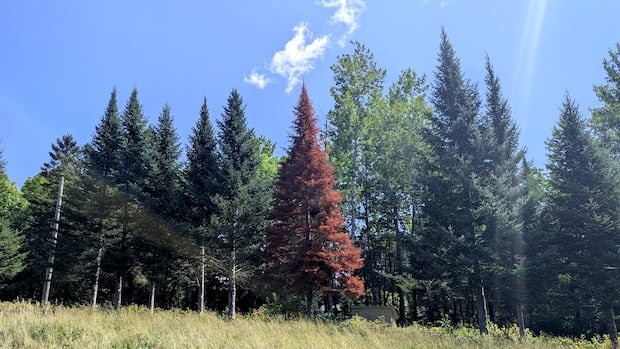
Balsam fir trees in New Brunswick are exhibiting red discoloration and decay following last year’s unprecedented drought, sparking concerns about the future of these iconic provincial trees. Professor Anthony Taylor, a forestry expert at the University of New Brunswick, has been closely monitoring reports from forest owners who have witnessed the distressing phenomenon firsthand. These vibrant evergreen trees, commonly sought after for Christmas decorations, are gradually withering and perishing due to the adverse effects of the prolonged dry spell.
According to Taylor, the observed pattern aligns with previous instances after hot and arid summers. He emphasizes that the warm and dry conditions, such as the recent drought, have a detrimental impact on the growth capacity of balsam fir trees. Taylor, who has been researching the influence of climate change on New Brunswick’s forests for an extended period, highlights that similar die-offs occurred following notably dry summers in 1986 and 2018.
The trees’ response to drought involves an early cessation of the photosynthesis process, hindering their growth. This disruption results in a reduced production of vital energy reserves necessary for sustaining metabolic functions and defense mechanisms, as explained by Taylor. Consequently, the trees become more susceptible to external stresses like pests or diseases, increasing the likelihood of widespread mortality.
Moreover, the shallow root system of balsam firs compounds their vulnerability during periods of low moisture availability. Peter McKeil, a woodlot owner who first noticed signs of damage in June, describes how the trees are progressively turning red from the lower branches upwards, with new affected areas emerging continuously. McKeil estimates a substantial loss of approximately 100 trees on his property and has adjusted his harvesting methods to salvage value from the remaining trees before further losses occur.
McKeil expresses concerns about the future survival of balsam firs in light of escalating climate change impacts. He anticipates that the species may face significant challenges, particularly in southern New Brunswick, and emphasizes the need for adaptive measures as environmental conditions evolve.
Taylor views the sight of red-dying trees this year as a poignant indication of the adverse consequences of climate change on New Brunswick’s emblematic balsam firs. He underscores the urgency for climate action, emphasizing the importance of transitioning away from fossil fuels and promoting sustainable forest management practices to mitigate the escalating effects of climate change. Taylor’s research serves as a tangible reminder of the pressing need for concerted efforts to address the underlying causes of environmental degradation and preserve the ecological integrity of New Brunswick’s forests.