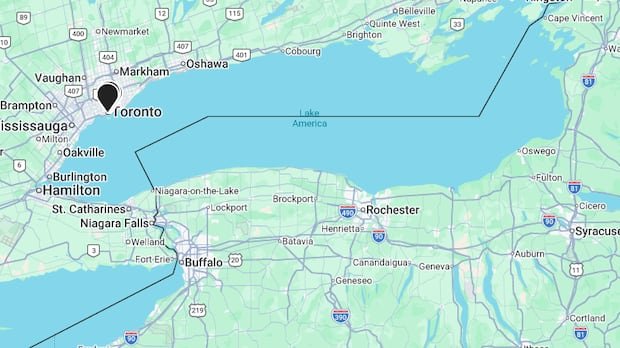
Some Canadian websites, including those for the federal government, showcased maps where Lake Ontario was labeled as Lake America on Sunday. This change followed Google Maps’ adjustment to comply with a directive from U.S. President Donald Trump, as announced the day before.
Google stated on its corporate site that the modification was made because the U.S. government’s geographic names database had officially renamed the lake. While Google mentioned that the alteration would impact U.S. users only, several Ontario and Canadian websites displayed Lake America on their maps.
Examples include Hydro One’s outage map, the Liquor Control Board of Ontario (LCBO) store locator, GO Transit’s station finder, and the federal government’s housing and infrastructure map. In response, Hydro One acknowledged the error in labeling Lake Ontario on their outage map, attributing the issue to a third-party mapping service.
Metrolinx, the agency that operates GO Transit, confirmed awareness of the situation and stated that they are reviewing their websites to ensure accurate labeling of Lake Ontario. By Sunday evening, the GO Transit map in question had been disabled, and the LCBO map had been rectified to display Lake Ontario once more.
While MapQuest declared that they would not change the lake’s name, Apple did not make any public statements on the matter. Google later clarified that website developers embedding Google Maps could select a region to localize the map, influencing how place names appear.
Tech analyst Carmi Levy explained that Canadian websites like those of Hydro One and the LCBO likely use Google’s application programming interface (API) for mapping, which is not location-sensitive. Consequently, these maps defaulted to displaying Lake America. Levy emphasized the importance of developers setting their region to Canada on the back end to localize their maps correctly.
Despite the confusion, search results within Canada should still show Lake Ontario, even if users input Lake America. Google updated its global search index to make Lake America searchable worldwide, with searches outside North America displaying Lake Ontario first, followed by Lake America in brackets.
The incident underscores the drawback of Canada’s reliance on American technology for online functionalities, further emphasizing the need for digital sovereignty. Ontario’s Minister of Public and Business Service Delivery and Procurement, Stephen Crawford, acknowledged the matter on social media, affirming ongoing efforts to ensure proper identification of Lake Ontario on provincial websites.
Ontario Premier Doug Ford criticized the name change, expressing confidence that the lake will retain its historical name, Lake Ontario. Ford unveiled a sign in Winona, Ont., reaffirming the lake’s identity. In response, Prime Minister Mark Carney emphasized that Lake Ontario will always be known by its original name.
As tensions between the U.S. and Canada escalate amid trade disputes, both countries have accused each other of making last-minute changes to proposed trade deals. Canada unveiled retaliatory measures in response to new U.S. tariffs, set to take effect on September 8.
Ford softened his stance on the trade war during an appearance on American TV, emphasizing the importance of returning to constructive trade negotiations. Trump’s executive orders to rename Lake Ontario and previously the Gulf of Mexico to Lake America and Gulf of America, respectively, have sparked online discrepancies, reflecting a broader issue of digital dependence on American technologies.


