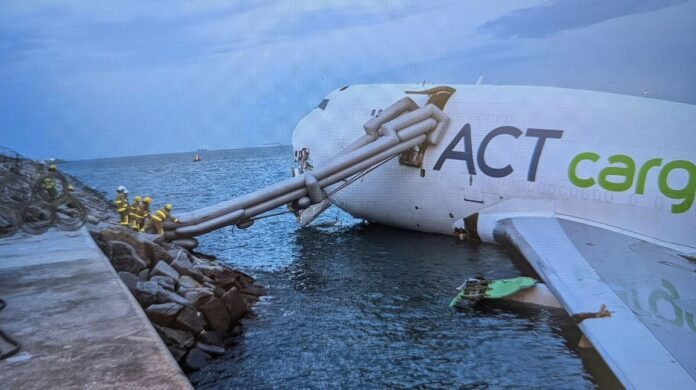
Tragedy unfolded at Hong Kong International Airport when an aircraft slid off the runway and crashed into the sea, resulting in the loss of two lives and the rescue of four crew members by emergency responders.
The incident involved Emirates flight EK9788, a cargo plane wet leased from Act Airlines, which was attempting to land after arriving from Dubai. The aircraft, a Boeing 747-400 with registration TC-ACF, sustained damage during the landing, although the crew members escaped unharmed as there was no cargo onboard.
The plane’s landing attempt at approximately 3:50 am local time on October 20 was marred by it veering off course, crashing through fences, and colliding with an airport security vehicle outside the runway. Tragically, this collision led to the vehicle being pushed into the sea, resulting in the deaths of two ground staff members.
Rescue efforts swiftly retrieved the four crew members from the aircraft with the assistance of the Fire Service Department. Steven Yiu, executive director of airport operations at Airport Authority Hong Kong, expressed deep condolences and assured support for the affected families.
Emergency services deployed 213 firefighters and first aid officers, along with 45 vehicles and ships, to the scene within minutes of receiving the distress call. Despite the tragedy, no distress call was made by the pilot to request assistance from air traffic control during the landing attempt.
The aircraft involved, a Boeing 747-481 (BDSF), had been in service for over 30 years, initially serving as a passenger plane before being converted into a freighter. On the day of the crash, it was being operated as Emirates SkyCargo Flight 9788, having been utilized by various airlines over the years.
The Hong Kong Air Accident Investigation Authority has initiated an investigation into the accident involving flight UAE9788, confirming the aircraft’s deviation from the designated runway and subsequent ditching into the sea. The investigation aims to ascertain the circumstances and causes of the accident to prevent similar incidents in the future, in accordance with aviation regulations and international standards.

