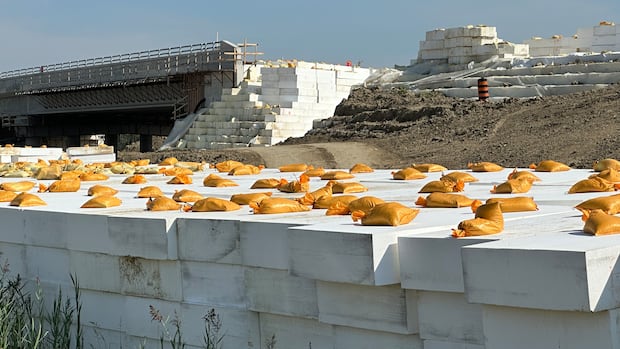
It’s hard not to notice: Numerous large, white blocks stacked several feet high near the new overpass project at the intersection of Banwell Road and E.C. Row Expressway.
Resembling giant Lego pieces, these blocks are not intended for play.
These structures are known as Expanded Polystyrene (EPS) geofoam blocks. According to the City of Windsor, they are being utilized to assist in constructing the embankments adjacent to the new overpass.
“EPS blocks are employed in construction to prevent ground settlement in a method referred to as ‘compensated foundations’,” explained Jill Braido, a spokesperson for the city, to CBC News.
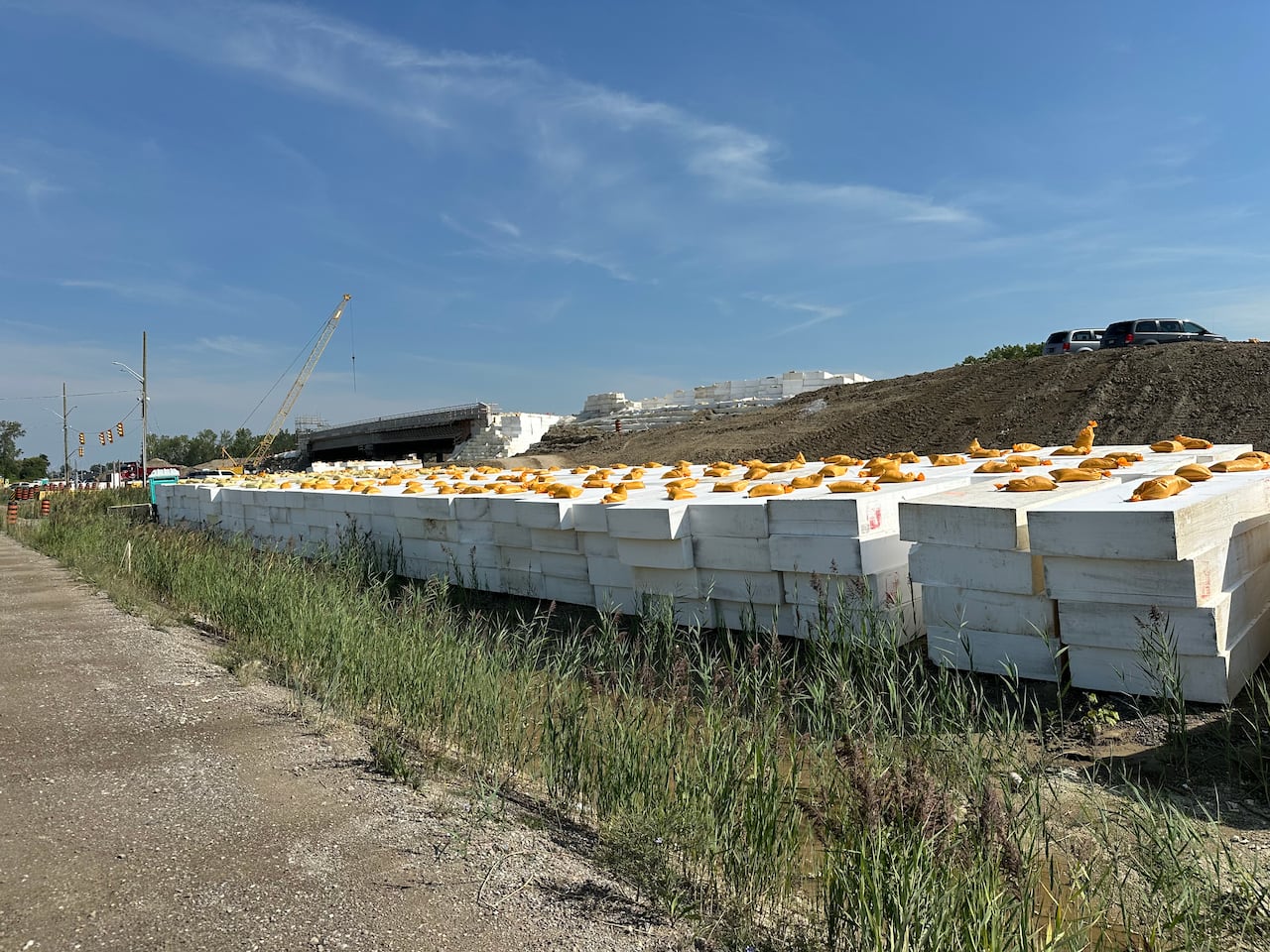
According to city officials, the Expanded Polystyrene (EPS) geofoam blocks are used to prevent “base ground settlements.” (Darrin Di Carlo/CBC)
Instead of constructing the bridge overpass approaches directly on standard soil, the workers replace a significant portion of the earth with EPS blocks prior to placing the final road surface on top, she clarified.
Mina Lee, a civil engineering professor at the University of Windsor, shared insights during an interview with CBC Radio’s Windsor Morning on Thursday, stating that the blocks are preferred over soil because geofoam is significantly lighter—100 times less than regular soil, which can be excessively heavy for the underlying ground.
“[The geofoam blocks] lessen the weight that is exerted below,” Lee noted. “Windsor has a lot of clay, which can be prone to settlement over time, so this helps in minimizing excessive settling as time goes by.”
Braido mentioned that this method will guarantee “long-term stability of the bridge overpass approaches while also reducing overall labor costs compared to using traditional heavy soil or gravel as the base material.”
This technique seems to be becoming a key component of Windsor’s road development.
The city also noted that these blocks were utilized in the construction of the Gordie Howe International Bridge, which was opened to vehicles in July.
Unlike conventional styrofoam that easily disintegrates in your hand, these blocks are designed to withstand pressure without cracking. Lee explained that the geofoam is highly dense, produced in a controlled setting, and engineered for the heavy loads it will support.
There are also environmental advantages.
“Due to the lightweight nature of [the geofoam blocks], they are very easy to transport, whereas dirt and soil necessitate multiple trips to the construction site,” Lee explained. “This ultimately leads to a reduction in greenhouse gas emissions associated with transportation.”
Additionally, Lee pointed out that the blocks are produced from recycled materials, which means “they can also be recycled after the infrastructure’s lifespan.”
Regarding their lifespan, Lee mentioned that the geofoam is expected to last between 50 to 100 years.