Birdsong varies widely, ranging from tweets to intricate melodies, resembling a symphony.
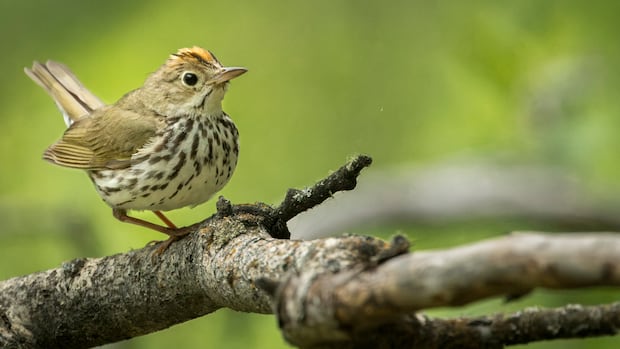
However, ovenbirds — stout, terrestrial warblers — possess a very limited set of sounds.
The male ovenbird has only one song, which is a quick tune often referred to as teacher-teacher-teacher.
To the untrained ear, all ovenbirds might appear identical in song, yet each bird has its own unique rendition.
Now, researchers are employing artificial intelligence to monitor the health of ovenbird populations based solely on their characteristic songs.
A study released this month in the journal Nature Methods utilized AI to differentiate individual ovenbirds in audio recordings collected from Alberta and Pennsylvania.
A Singular Focus
The unique song selection of the ovenbird made it a prime candidate for this research, according to lead investigator Sam Lapp, a postdoctoral researcher at the University of Colorado.
“These birds are quite faithful to singing one particular song,” Lapp remarked in an interview with CBC News.
“Many birds tend to establish a vocal signature over their lifetime, often incorporating multiple songs into what we define as their repertoire.
“Conversely, the ovenbird is notable for having just one very stable song throughout its life and singing only that version.”
Ovenbirds perform their primary song during the spring to assert their territory and attract partners, maintaining this pattern throughout their lives.
Under Lapp’s guidance at the Department of Biological Sciences at the University of Pittsburgh, the research team analyzed recordings amassed from nearly 130 locations in Pennsylvania over a four-year period.
They developed an AI model to identify features that rendered songs unique and grouped similar songs together, assuming each bird would return to its specific forest area each spring.
The team processed a total of 9,072 hours of audio to monitor 405 individual birds. They then validated the model with another set of recordings obtained from the mixed wood and boreal forests in Alberta during the 2016 spring breeding season.
Lapp noted that the model could accurately associate songs with individual birds up to 96 percent of the time.
This method is far less labor-intensive compared to traditional leg banding, where biologists capture birds, affix markers around their legs, and attempt to recapture them in the following spring.
He explained that the research idea originated from a collaboration with biologists in Alberta who were trying to locate birds over large areas using a network of microphones.
Astonishing Discoveries
According to Lapp, human ears are unable to differentiate individual ovenbirds in real-time due to the rapid nature of their vocal nuances.
However, on spectrographs — visual displays of sound — the unique songs of each bird become apparent, Lapp stated.
“I began to consider whether, if I can see these patterns with my eyes, we could teach a machine to recognize them and automate the individual recognition process,” he elaborated.
“Even for those who are passionate about birds and keen on identifying species, it’s surprising and thrilling to realize that this level of detail exists, yet we have been overlooking it … but it is present if you listen closely enough.”
Erin Bayne, a biology professor at the University of Alberta and co-author of the study, has been listening to ovenbirds for years and is familiar with the challenges of annual population monitoring.
During his doctoral studies, Bayne dedicated thousands of hours to tracking banded birds, ultimately becoming adept at distinguishing them by their unique vocal differences.
“What that bird over there is saying is slightly different from what the one over here is saying,” he remarked. “I could identify each one.
“They are incredibly courteous when they sing. It’s quite amusing, actually. One bird will sing, and then another will wait for him to finish before immediately responding.”
Communicative Birds
Bayne explained that the findings indicate avian communication is far more intricate than most people realize, suggesting that conversations occur even if we don’t comprehend the language.
Just as humans exhibit distinctive speech patterns, biologists are discovering that certain animals also cultivate their own vocal identities, Bayne noted.
“It’s not surprising that individual birds or animals possess detectable differences. I believe as we continue our research, it will become clear that this is indeed the case.”
While the model has its limitations, the researchers are optimistic it offers a non-invasive method to assess the health of songbird populations simply by listening.
The AI system is unable to accurately monitor the varied calls of female ovenbirds or the basic sounds made by young birds.
Additionally, the current program would be inadequate for tracking species like magpies and mockingbirds, which frequently mimic new sounds and possess extensive singing repertoires.
It is most effective for birds that maintain a single, unchanging song throughout their lives — approximately 30 percent of songbird species — along with certain bats and owls.
The team has made the program code available on open-source platforms to assist other biologists in monitoring the survival of various songbird populations or even different species.
Richard Hedley, a statistical ecologist with the Alberta Biodiversity Monitoring Institute and not part of the research team, stated that the study holds remarkable potential.
While AI acoustic monitoring has been utilized to track birds at the species level for some time, demonstrating its ability to differentiate between individual birds is a notable achievement, he explained.
A wealth of existing acoustic recordings could be utilized in innovative ways, he added.
“It can take countless hours to capture a single bird. Thus, the notion that we can achieve this by simply placing a microphone in the bird’s habitat is extremely promising.”
Tag: rewrite-pending