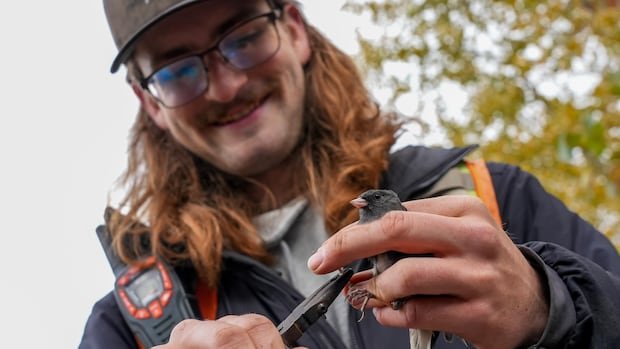
In the heart of the boreal forest, Ethan Denton carefully handles a dark-eyed junco, a small songbird, near a series of nets. Denton, an ornithologist from Calgary spending his summer in Fort McMurray, Alberta, attaches a light aluminum band with an identification number to the junco’s right leg using pliers.
After noting the bird’s gender and measurements, Denton releases it, contributing to a broader effort by researchers across North America to track migration patterns. Ken Foster, a co-founder of the Wood Buffalo Wildlife Research Institute (WBWRI), observes the process, emphasizing the institute’s commitment to long-term bird monitoring in the oilsands region.
Foster highlights the importance of understanding bird population trends and potential decline factors, expressing hope that research efforts can aid in reversing such declines. The institute, established as a non-profit in 2024, aims to engage volunteers in wildlife research initiatives alongside professionals like Denton.
Data collected by Foster’s consulting company, Owl Moon Environmental Inc. (OMEI), indicates varying responses among bird species to environmental changes in the oilsands region. Some species, such as the least flycatcher and northern waterthrush, have experienced significant population decreases due to habitat alterations from wildfires, industrial activities, and shifts in food availability.
In contrast, adaptable species like clay-colored sparrows thrive in disturbed habitats, showcasing resilience in areas affected by human activities and natural events. Foster acknowledges the support received from energy companies for his research and emphasizes the importance of enhancing public outreach and educational opportunities through WBWRI projects.
Local studies, like those conducted by Foster and his team, play a crucial role in identifying regional challenges and informing broader conservation efforts. Erin Bayne, a biology professor at the University of Alberta, underscores the significance of integrating local data with national databases to address environmental concerns effectively.
Beyond bird banding initiatives, WBWRI is expanding its research scope to include tracking tower installations for animals with radio transmitters, with plans to monitor bat populations and provide wildlife rehabilitation training for volunteers in the Fort McMurray area. Foster envisions these programs as essential for quantifying environmental changes and fostering community engagement in conservation efforts.


