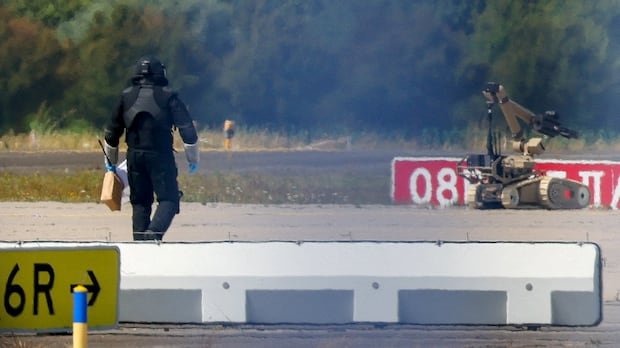
German authorities are probing a drone containing explosives and a detonator discovered at Leipzig airport, as Russian Foreign Minister Sergey Lavrov hints at Moscow’s plans to increase retaliation against nations aiding Ukraine. Lavrov, speaking to VGTRK, Russia’s state media, stated, “We will employ more severe measures to dismantle all support for Kyiv’s war machine provided by the West.” He added, “We are already taking action.”
The investigation was triggered after an airport staff member found a drone carrying an unidentified explosive device in the cargo operations zone’s security area near the south runway of Leipzig airport, labeled as “critical infrastructure.” Leipzig serves as a pivotal NATO airport facilitating the transport of armaments, ammunition, weapons, and military gear to Ukraine through flights operated by Ukrainian cargo firms.
The presence of the drone alongside one of the Ukrainian cargo planes is deemed a significant security threat by Germany’s interior minister, Alexander Dobrindt. He emphasized that the incident appears to be part of a sophisticated hybrid threat scenario, ruling out amateur involvement.
While German authorities are scrutinizing the matter, they have refrained from identifying the drone’s origin. However, recent intelligence reports from U.S. officials to the Wall Street Journal suggest potential links to the Russian government. Berlin is taking cautious steps by bolstering anti-drone capabilities and refraining from premature accusations.
Dobrindt highlighted the evolving threat landscape, warning of Russia’s utilization of drones, espionage, sabotage, and influence operations across Europe, particularly ahead of the upcoming regional elections in Germany. He stressed the ongoing challenges posed by daily hybrid warfare targeting Germany.
The Institute for Strategic Dialogue (ISD) has been monitoring Russia’s online interference in Germany through a campaign known as Operation Overload. The initiative aims to exploit issues within NATO member countries and Ukraine, focusing on Germany, France, and Ukraine, with tactics aimed at undermining Ukraine’s military efforts and destabilizing democracies.
Dobrindt acknowledged the attempts to influence German politics and society, particularly during regional elections, cautioning about disinformation efforts by adversaries. Hans-Jakob Schindler, senior director of the Counter Extremism Project, viewed the Leipzig drone incident as a forceful escalation of Russia’s interference tactics, raising concerns about the threshold between defense and direct conflict.
Schindler emphasized the need to establish clear boundaries with Russia regarding hybrid warfare operations and prevent potentially deadly outcomes on German soil. He interpreted Lavrov’s statements as a departure from Russia’s previous denials of interference in Western countries, signaling a more aggressive stance against Europe, the West, and NATO.