Provincial wildlife authorities are pleased to receive reports of uncommon canids, such as coyotes and wolves, as they persist in monitoring and enhancing their understanding of these animals’ presence on the island and in Labrador.
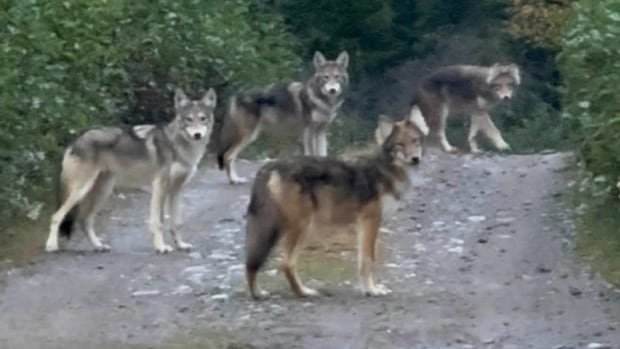
Recently, the possibility of wolves on the island was raised when Nikita Compton encountered and shared images online of a small group of animals near Goose Arm, located between Deer Lake and Corner Brook, sparking conjecture. People wondered if they were a hybrid of coyotes and dogs or even a mix of coyotes and wolves.
Even though it is challenging for wildlife officials to definitively identify the animals without testing, they aim to gain a better comprehension of the overall canid population.
The Government of Newfoundland and Labrador’s Department of Forestry, Agriculture, and Lands, which supervises the Wildlife Division, disclosed in an email that a Newfoundland wolf, believed to be distinct from the Labrador wolf, is now extinct, having disappeared since the 1930s. However, Labrador gray wolves have been more recently observed on the island, with initial sightings in 2008 and 2012.
Since 2013, the Wildlife Division has been investigating the movement of these animals. Biologists have conducted genetic examinations on approximately 500 canid carcasses collected in the province. Among them, five animals exhibited a mix of coyote and domestic dog ancestry, while four animals from the island were confirmed to be Labrador wolves. Additionally, 28 samples showed evidence of some level of wolf DNA.
There are 427 more samples from deceased animals collected between 2023 and 2025 awaiting genetic testing results. It is noted that the wolf population on the island is limited, with genetic evidence indicating interbreeding with coyotes, although the larger coyote population suggests that wolf genetics are likely to remain diluted within the island’s canid population.
It can be challenging to discern the genetic background of a coyote solely based on appearance, as coyotes naturally vary in size, color, and body proportions. However, the interest in understanding the canid mystery is encouraged to aid ongoing research on animal life in the province.
Hunters and trappers are incentivized to provide coyote and wolf carcasses for study, as this information helps in assessing the impact of coyote colonization on the island and understanding the movement of wolves from Labrador to the island. Efforts are being made to increase the number of canid samples from Labrador to enhance the detection of animals with wolf genetic ancestry.
In cases where individuals encounter a coyote or wolf, provincial wildlife authorities advise remaining calm and avoiding encouraging contact or feeding wild animals. If approached by a coyote or wolf, individuals are recommended to stay calm, make noise, wave their arms to appear larger, and slowly back away if the animal does not retreat.
Lastly, it is emphasized that coyotes and wolves are typically not aggressive towards humans. The public is urged to maintain caution and follow safety protocols when encountering these animals.