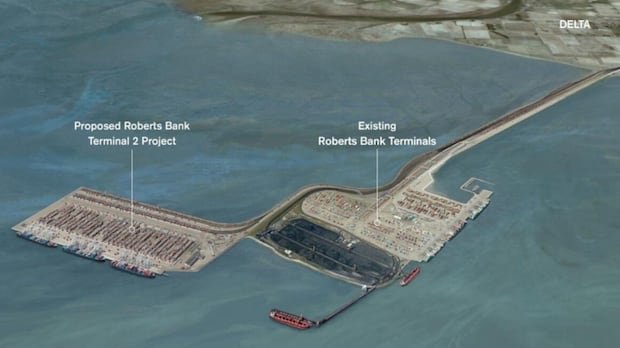
The Canadian government is moving forward with the process to potentially classify the Roberts Bank Terminal 2 port expansion in Metro Vancouver as a project of national significance. A notice published in the Canada Gazette on August 29 initiates a 30-day consultation period to determine if listing the port expansion under the Building Canada Act as a project of national interest is appropriate. This designation would enable expedited approval processes, including environmental assessments, for projects considered to be in the national interest.
The Liberal government has highlighted the potential benefits of both the Roberts Bank Terminal 2 (RBT2) port expansion and the Mackenzie Valley Highway project in the Northwest Territories, stating that these projects could enhance Canada’s transportation and trade networks and contribute to the country’s long-term economic sovereignty. However, environmental organizations have expressed concerns that expediting the approval of the port expansion may allow the government to circumvent environmental protections.
The RBT2 project, spearheaded by the Vancouver Fraser Port Authority, proposes a three-berth container terminal that would boost the port’s capacity by nearly 50% and create approximately $100 billion in annual trade capacity, according to the port authority. Although the federal government granted approval for the project in 2023, imposing 370 legally binding conditions to address environmental issues, additional conditions were added when British Columbia issued an environmental assessment certificate the same year.
Both levels of government acknowledged the potential adverse environmental impacts of the project but deemed them justified in the circumstances. The RBT2 project is currently in the process of obtaining final environmental permits, including approval from Fisheries and Oceans Canada regarding compliance with the Species at Risk Act (SARA). If granted national-interest status, the project could receive exemptions from certain SARA requirements.
In July, Prime Minister Mark Carney announced $10 billion in federal support for the port expansion project as part of a broader agreement with British Columbia. The proposed expansion is planned for the Fraser River estuary, a crucial habitat for numerous endangered species, raising concerns among environmentalists about the potential ecological impacts.
Environmental advocacy groups, such as Environmental Defence, have criticized the government’s push to fast-track projects like the port expansion, fearing that it prioritizes development over environmental protection. They argue that such actions could come at the expense of vulnerable species like the southern resident killer whales and chinook salmon, which rely on the affected habitat for survival.
Efforts to mitigate environmental concerns include habitat restoration plans and measures to protect southern resident killer whales, such as ship slowdown programs to reduce underwater noise. However, critics like Julia Levin from Environmental Defence caution that the government’s eagerness to expedite major projects risks undermining environmental safeguards and species protections in favor of project development.
Proposed changes to environmental regulations, including the Species at Risk Act, have raised alarms among scientists and conservationists, who warn that these modifications could weaken crucial protections for endangered species. The government’s consideration of exemptions from certain environmental assessment requirements has sparked debate and calls for more thorough deliberation to ensure environmental conservation is not compromised for the sake of industrial development.