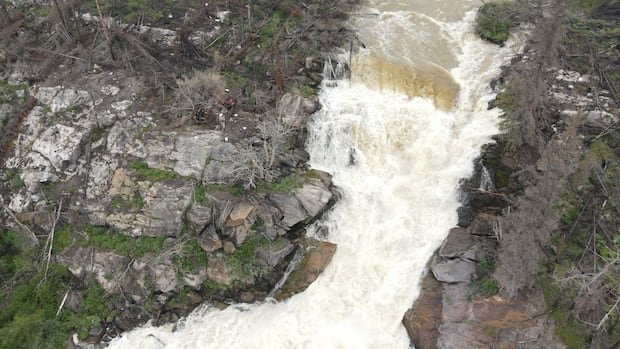
Two scientists have conducted a new assessment of a remote waterfall, indicating that the seldom-visited falls in the rugged boreal shield of northern Manitoba could be the tallest in the province. Alexander Martin and Lukas Olson utilized digital photogrammetry to measure Kapakaytay Falls on the Odei River. Their initial findings suggest a height of 16 meters, slightly surpassing the 14-meter height of Kwasitchewan Falls, located southwest of Thompson, which is widely recognized as Manitoba’s tallest waterfall.
Olson, a PhD candidate at the University of British Columbia specializing in photogrammetry, expressed confidence in the measurement accuracy, with a margin of error of around one meter. While Kapakaytay Falls was previously measured by the federal government decades ago and recorded as 58 feet on topographical maps, this information was not widely disseminated, according to Martin, a Winnipeg resident and PhD student in ecology at the University of Oxford.
The researchers embarked on their expedition in July, navigating the challenging Odei River located about 40 kilometers northwest of Thompson and 690 kilometers north of Winnipeg. Accessing the waterfall required meticulous planning, whitewater expertise, and wilderness acumen due to the remote and rugged terrain. After a demanding 105-kilometer round trip, facilitated by local guides, Olson and Martin were mesmerized when they approached the waterfall, marveling at its grandeur and the force of the water cascading over the rocks.
Inspired by a previous journey in 2019, the researchers used over 1,000 two-dimensional images captured by a drone to reconstruct and measure the waterfall through digital photogrammetry. Their model also incorporated laser measurements of surrounding trees and natural elements. The team’s analysis suggests that Kapakaytay Falls could be approximately 16 meters high, potentially surpassing other notable waterfalls in the region.
In response to the province’s assertion that Kwasitchewan Falls remains the tallest based on their data, the researchers are striving to publish their findings and contribute to the ongoing understanding and exploration of this remote site. Martin emphasized the importance of documenting lesser-known natural wonders, emphasizing that there are still opportunities for exploration and discovery despite extensive global mapping efforts.