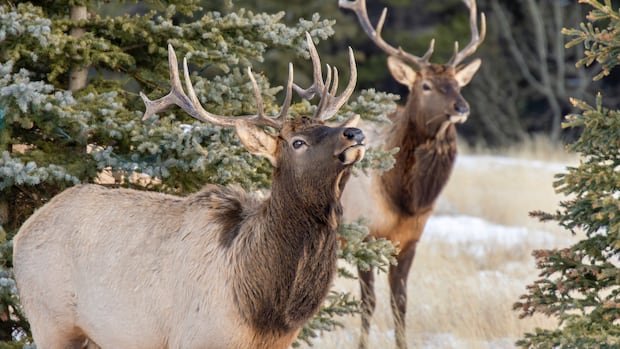
Amidst vibrant orange larch trees, a resonant call reverberates through the Bow Valley as the fall mating season is in full swing for male ungulates in North America. This includes elk, commonly found across much of Alberta. During this time of year in the Canadian Rockies, it is typical to witness and hear bull elk asserting their dominance.
Despite the hauntingly familiar bugle call echoing across the continent, recent research suggests that elk in various regions may actually communicate with distinct dialects. Jennifer Clarke, a biology professor at the University of La Verne in California, conducted a study on elk populations in Colorado, Pennsylvania, and Wyoming. These populations, which have been isolated for extended periods, have developed unique communication styles akin to human populations separated over time.
The bugling of bull elk serves as a form of aggression signaling dominance and readiness to challenge other males. The bugles can also convey information about the age and size of an elk, with younger bulls emitting higher-pitched calls compared to mature dominant males.
Although the reasons behind the regional dialect variations remain unclear, initial hypotheses relating to habitat differences were disproven. Clarke’s team expected elk in Pennsylvania, residing in dense deciduous forests, to produce lower-pitched calls for better sound propagation compared to elk in Wyoming and Colorado, inhabiting more open and dry environments. However, the data revealed that all three populations had distinct dialects, indicating that habitat alone does not drive these differences.
Possible factors such as genetics or learning may contribute to the elk dialect variations, with ongoing research exploring these aspects further. Clarke noted that Pennsylvania elk exhibit greater genetic similarity due to low heterozygosity, resulting in more uniform calls within the population. In contrast, elk in Colorado and Wyoming display more diverse vocalizations within their respective populations.
As for Canadian elk, Clarke refrained from speculating on potential differences, emphasizing the need for further research. With the elk mating season underway in the Canadian Rockies, caution is advised due to the heightened aggressiveness and unpredictability of bull elk during this period. A study conducted across Canadian national parks revealed that elk were involved in a significant portion of aggressive wildlife encounters, emphasizing the importance of giving these animals ample space to avoid conflicts.
Nick de Ruyter, program director of the BioSphere Institute’s WildSmart program, highlighted the need for caution around elk in public spaces, particularly during the rutting season when male elk are especially aggressive. Encounters with elk can be triggered by close proximity, emphasizing the importance of maintaining a safe distance and respecting these animals’ space to prevent potential conflicts.