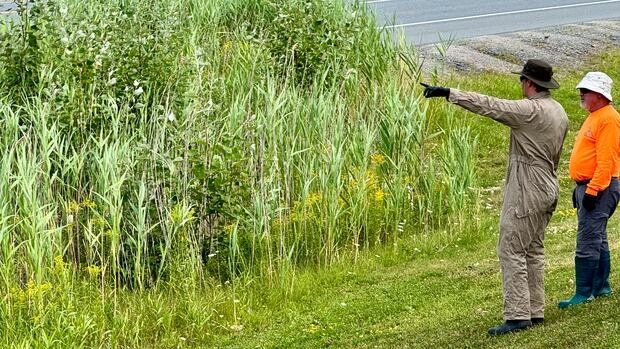
An exotic plant is extending its reach further into northern Ontario, prompting local communities to collaborate on strategies to detect and manage it before it establishes a strong foothold. The Junction Creek Stewardship Committee, based in Sudbury, organized a workshop in partnership with the Invasive Phragmites Control Centre to educate individuals on recognizing invasive phragmites and preventing its proliferation. Invasive phragmites, commonly known as common reed, has the potential to form dense clusters that displace indigenous flora and disrupt wetland ecosystems. Jayden McGleish, a field supervisor at the Invasive Phragmites Control Centre, highlighted the plant’s encroachment into northern Ontario, citing substantial patches emerging in Sudbury.
Invasive phragmites can rapidly outcompete native vegetation like cattails and bulrushes, creating obstacles for wildlife movement. McGleish mentioned instances of turtles and frogs struggling to navigate through dense phragmites, resulting in unfortunate fatalities. Moreover, the plant poses challenges in recreational areas by encroaching on shorelines and impeding access. Its growth along roads and through asphalt also presents financial burdens to municipalities by damaging drainage systems and road infrastructure.
Although the plant is more prevalent in southern Ontario, it is increasingly being detected in northern locales such as Sudbury, Sault Ste. Marie, Timmins, and Thunder Bay. Erik Barr, a contract worker at Conservation Sudbury, expressed optimism about Sudbury’s ability to contain the invasive species before it spreads uncontrollably. He emphasized ongoing efforts to manage the plant within the region.
Distinguishing between invasive and native phragmites is crucial, as not all phragmites species are invasive. Barr highlighted that northern Ontario hosts a native phragmites variety that typically grows intermixed with other plants rather than forming dense clusters like the invasive type. The invasive variant is characterized by broader leaves and thicker stems compared to the reddish hue present on the native phragmites stems. Another distinguishing feature is the thin brown line at the leaf-stem junction in invasive phragmites, contrasting with the thicker line in native phragmites.
Educating the public on differentiating between native and invasive phragmites is essential for monitoring and mapping the plant’s spread, noted Jaclyn Groom from the Junction Creek Stewardship Committee. She underscored the need for awareness, especially in areas where human activities may inadvertently aid in the plant’s dissemination. The plant’s affinity for metal-rich soils near mining sites and tailings areas in Sudbury has raised concerns about potential further spread from locations like Copper Cliff Creek, which flows into Junction Creek.
Chuck Simpson, manual controls manager at the Invasive Phragmites Control Centre, reassured that while the situation in Sudbury may seem severe initially, the prevalence of native phragmites alleviates the extent of the invasion. Simpson explained the treatment methods for invasive phragmites, emphasizing the use of backpack sprayers and the herbicide Timberline. The workshop included a demonstration of treatment procedures, showcasing the effectiveness of these methods in reducing phragmites populations. Simpson highlighted the high success rate of the treatment, aiming for significant eradication within weeks of application to curtail regrowth.
Overall, collaborative efforts and public awareness are crucial in combatting the spread of invasive phragmites in northern Ontario.