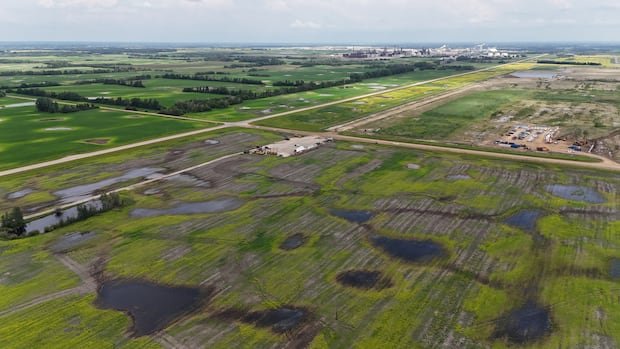
Artificial intelligence data centers are known for their significant electricity consumption, raising concerns about potential impacts on energy costs for consumers in Alberta. A recent report from the Pembina Institute suggests that the Meta Data Centre planned for Sturgeon County could lead to an annual increase of $270 to $460 in household power bills once operational.
These data centers, housing computing hardware for various AI applications, have been responsible for 4.4% of U.S. electricity demand in 2023, a figure projected to potentially rise to 12% by 2028. Meta Platforms Inc., the parent company of Facebook and Instagram, is set to construct a $13 billion data center complex near Edmonton within the next few years.
The Meta Data Centre will be linked to the $4.6 billion Greenlight Electricity Centre, expected to provide 932 megawatts of power with the potential for expansion. Despite assurances from the provincial government and Meta that the data center will not increase electricity costs for Albertans, experts warn of a possible price increase due to the delay between the data center’s operation and the power plant’s completion.
The report indicates that electricity prices may rise significantly until additional power supply becomes available, particularly between 2027 and 2031. The impact of large projects like Meta’s data center on electricity prices depends on the synchronization of new generation capacity with increased demand.
As Meta’s data center could consume nearly one gigawatt of electricity, equivalent to about 10% of Alberta’s current generating capacity, concerns arise about potential strains on the power grid. The report suggests a possible 15% increase in electricity prices, emphasizing the importance of balancing supply and demand dynamics to mitigate cost impacts.
While the Alberta government aims to attract tech giants like Meta, the Pembina report warns of potential long-term effects if more data centers are built in the province. Experts highlight the importance of renewable energy sources, battery storage, and demand management to address the electricity demand surge from data centers.
In response to concerns about electricity costs, Meta has committed to funding new generation and grid infrastructure to benefit Albertans. The federal government has also introduced principles for responsible data center development, emphasizing transparency, environmental impact mitigation, and local benefits. Amidst these developments, the debate continues on the balance between data center expansion and maintaining affordable electricity for consumers in Alberta.