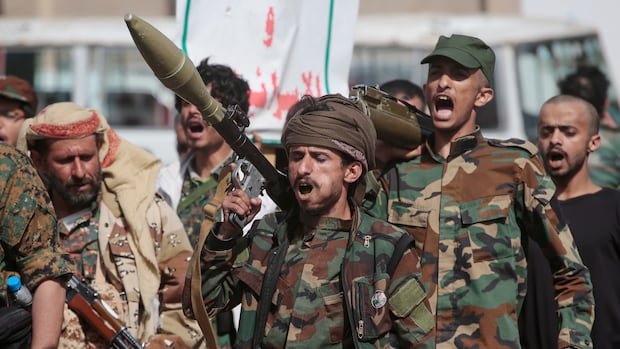
Almost three years following the Houthis gaining global media attention for assaulting commercial ships near Yemen, the rebels have expanded their violent dominance in the Middle East. Let’s delve into the group that has been a persistent problem for Israel, Saudi Arabia, the United States, and international maritime routes, potentially impacting global oil prices.
The Houthis are a faction involved in the Yemeni civil conflict that claimed over 100,000 lives before a fragile truce was reached in 2022. On the opposing side stands the internationally recognized government supported by a Saudi-led coalition.
Originating in the 1990s, the Houthi movement emerged when the Houthi family in northern Yemen established a religious revitalization group for the Zaydi sect of Shia Islam. The movement escalated into a civil war in 2014 as the Houthis rebelled against the government, seizing control of Sanaa, the capital.
In early 2015, Saudi Arabia, backed by other Gulf nations and with U.S. assistance, initiated airstrikes against the Houthis, who receive support from Iran. The ensuing proxy war inflicted severe devastation on the impoverished nation, resulting in a death toll of approximately 150,000 and triggering a dire humanitarian crisis.
Although violence subsided after a UN-brokered ceasefire in April 2022, the Houthis redirected their aggression towards Israel and Red Sea shipping routes following Hamas’s attack on Israel in October 2023. These assaults on Red Sea vessels led to the sinking of two ships, with four sailors losing their lives by the end of 2024. The Houthi attacks tended to cease during Gaza ceasefires, with a temporary halt in assaults on American ships due to nearly two months of U.S. airstrikes.
Recent developments indicate a breakdown of the 2022 truce, potentially reigniting civil strife in Yemen and posing a threat to global commodity prices. The fragile peace shattered in July when the Houthis resumed attacks on Saudi Arabia in response to a Saudi airstrike on Sanaa’s international airport, intensifying tensions in the region.
The Houthi offensive extended to the strategic island of Perim in the Bab al-Mandab Strait, a crucial global shipping lane. The Strait of Hormuz, on the other side of the Arabian Peninsula, remains a contentious point between Iran and the U.S., with Iran claiming to have targeted ten ships near the Strait of Hormuz in retaliation for the sinking of five Iranian oil tankers by the U.S.
According to the Institute for the Study of War, disrupting Red Sea traffic via Houthi control over the Bab al-Mandab could enable Iran to exert pressure on the U.S. and Gulf allies, impacting energy and shipping flows and imposing economic costs on Gulf nations.
Saudi Arabia, a major oil exporter, heavily relies on the Red Sea route since the Iran conflict effectively closed the Hormuz Strait, a vital oil transit point.
The Houthis aspire to establish a strict Shia theocracy encompassing all of Yemen, positioning themselves as equal partners to Iran rather than mere proxies. Both entities aim to diminish U.S. influence in the region, implementing their regional order vision, although their objectives occasionally diverge.
The wave of attacks led to record-high shipping costs for large oil tankers, while global oil prices surged above $100 per barrel for the first time since July. The Suez Canal route plays a vital role in global seaborne commodity shipments, particularly for oil and fuel bound for the Mediterranean and Asia, including Russian oil.
Approximately 12 to 15 percent of global trade passes through the Red Sea annually, and vessels bound for Europe avoiding the Suez Canal must take the longer route around Africa.
Saudi Crown Prince Mohammed bin Salman sought U.S. assistance to combat the Houthis as their threat to the Red Sea escalated. While the U.S. declined direct military intervention, they offered intelligence sharing and targeting support.
Iran may seek to close the Bab al-Mandab Strait to pressure the U.S., but the Houthis may opt for a less severe approach to avert retaliation, as per the ISW reports. A Houthi military spokesperson assured safe maritime navigation, except for Saudi vessels under a previously declared ban.