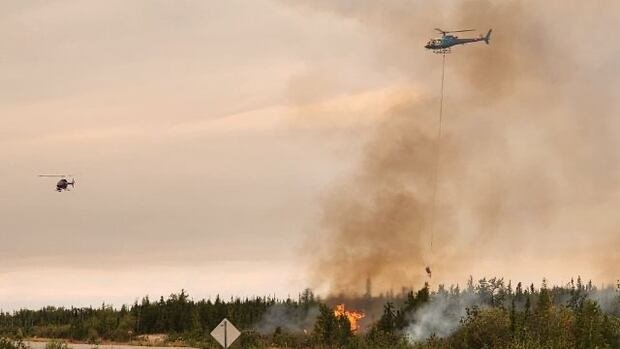
Data released by the Northwest Territories (N.W.T.) government reveals a significant increase in evacuation orders over the last six years compared to the previous three decades combined. The N.W.T. Department of Municipal and Community Affairs (MACA) provided information in response to a request from CBC News regarding the number of communities that required evacuation since the 1990s.
The data indicates a total of 32 evacuation orders were issued between 1990 and 2019, which mirrored the same number issued between 2020 and 2026. These evacuations were primarily triggered by wildfires, floods, and sporadic emergencies such as the 2019 apartment fire in Hay River.
Not all evacuation orders were specific to communities, as some pertained to residences along highway sections. The dataset also encompassed partial evacuations, where neighborhoods had to relocate within the same town.
Mike Flannigan, a wildland fire expert at Thompson Rivers University in Kamloops, British Columbia, expressed surprise at the surge in evacuations. He questioned whether historical wildfire evacuations were accurately documented since they were not as meticulously tracked in the past.
CBC News sought additional information on wildfire evacuations from the federal government, but only data dating back to 1980 was available, lacking a breakdown by decade. However, Flannigan emphasized the clear trend depicted in the N.W.T. government’s data.
The escalation in evacuations is predominantly attributed to wildfires, with Flannigan attributing this rise to several factors. He pointed out that the increasing incidence of fires is linked to human-induced climate change, leading to longer warm seasons that foster more lightning strikes, a common cause of wildfires in the region.
Fires now exhibit different behaviors compared to the past, with some fires spreading rapidly and intensely, making containment challenging. Consequently, evacuations are being initiated earlier as a precautionary measure.
The data highlighted several communities that had to evacuate multiple times, with Hay River and Kátł’odeeche First Nation topping the list with a total of 12 evacuations since 1990.
Emergency management practices have evolved in response to the surge in evacuations. Former N.W.T. director of public safety, Kevin Brezinski, noted the heightened frequency and intensity of fires in recent years, necessitating a more focused approach on emergency measures.
In a post-event review in 2025, the territory documented recovery costs amounting to $363.8 million from floods and fires since 2021. Brezinski emphasized the shift towards a more specialized approach in emergency management, reflecting the escalating priority placed on emergency measures.
While evacuations were less common in the past, severe fire seasons are not uncommon in the N.W.T. One notable event recounted in the government’s data was the 1995 fire that nearly engulfed Tulita. The community still commemorates this event with “fire day” activities.
Residents like Shelley Melto from Norman Wells recollect the trauma of past evacuations, such as the 1995 incident, which continues to evoke strong emotions whenever new evacuation orders are issued. The data underscores that experiences like Melto’s are becoming increasingly common in the N.W.T.