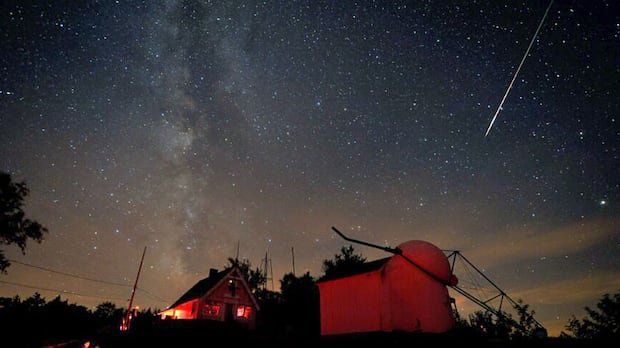
Every August brings one of the most spectacular meteor showers of the year: the Perseids. This year, coinciding with the peak of the shower, a partial solar eclipse will be visible.
The Perseids are renowned for their abundance and brightness, often considered the premier meteor shower due to these factors and typically favorable viewing conditions. Meteor enthusiasts will be pleased to know that the peak viewing night is set for Aug. 12-13, which aligns with a new moon phase, ensuring optimal visibility without moonlight interference.
Peter Brown, a Canada Research Chair in Meteor Astronomy at Western University, anticipates a noteworthy occurrence this year: an abundance of Earth-grazing meteors. These meteors enter the Earth’s atmosphere before returning to space, characterized by their brightness and speed, creating a stunning visual display.
The meteor shower is anticipated to peak around midnight Eastern Daylight Time, potentially producing up to 120 meteors per hour under optimal dark-sky conditions. While such high numbers may not be visible to the naked eye, the increased overall rate enhances the likelihood of witnessing a dozen or more bright meteors during the early evening.
Meteor enthusiasts need not wait until the peak night to catch a glimpse of the Perseids, as the shower commenced on July 17, progressively intensifying as it approaches the peak. Monitoring the weather forecast is advised, with consideration given to observing on nights leading up to the peak if cloudy conditions are anticipated.
To maximize meteor sightings, clear sky conditions are essential. It is recommended to avoid using phones that emit light, as it hinders dark adaptation of the eyes. The radiant point of the Perseid meteors is situated in the constellation Perseus, though meteors can streak across the entire sky.
Apart from the Perseids, two other significant meteor showers, the southern delta Aquariids and the alpha Capricornids, are currently active, offering additional opportunities to witness shooting stars. Additionally, a minor shower known as the kappa Cygnids produces around three meteors per hour at its peak, complemented by sporadic meteors.
In addition to the meteor shower, a partial solar eclipse is set to occur on Aug. 12. While Canada will not experience a total eclipse, observers will witness the moon partially obscuring the sun. It is crucial to take precautions by using approved solar eclipse glasses to safely view this natural phenomenon. Astronomers emphasize the eclipse as a remarkable event showcasing celestial dynamics involving the Earth, moon, and sun.
This celestial extravaganza marks a unique opportunity for stargazers and astronomy enthusiasts to witness the wonders of the universe in action.